

$88M NYSEG FLAIR powerline draws concern from Enfield, Newfield Boards; neighbors
by Robert Lynch; December 4, 2025
It is aging infrastructure older than most of us. We’ve taken it for granted; long accepted it for what it is.
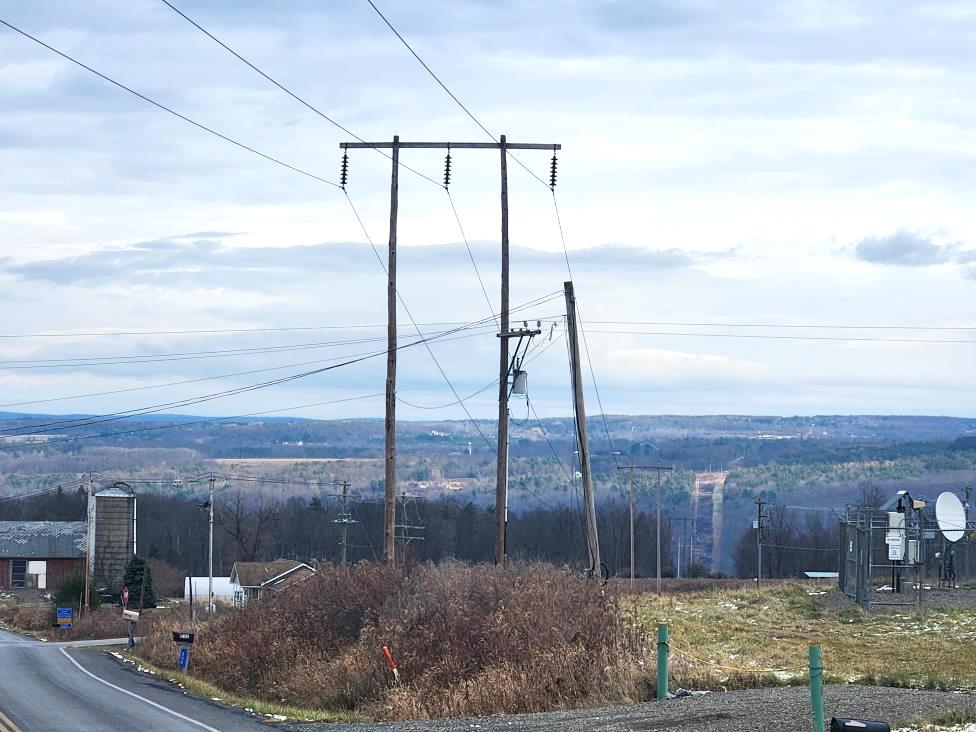
But if the power company has its way, that wooden nonagenarian on stilts will soon die a quiet, unheralded death and vanish from the landscape to usher in its 21st Century replacement; a bolder, taller-standing offspring set to strut its copper-brown steel self across the rural landscape of Enfield’s southwestern corner and Newfield’s northern edge. Some call it progress. Others hate it. They’d prefer that the old, wooden granddaddy live on forever.
“It’s a terrible idea,” Enfield Town Planning Board member Rich Teeter opined at the Planning Board’s November fifth meeting. “They’ll be ruttin’ all over on the land. I don’t like it. I like stuff the same, and they’re changing it, and I guess I don’t have a choice.”
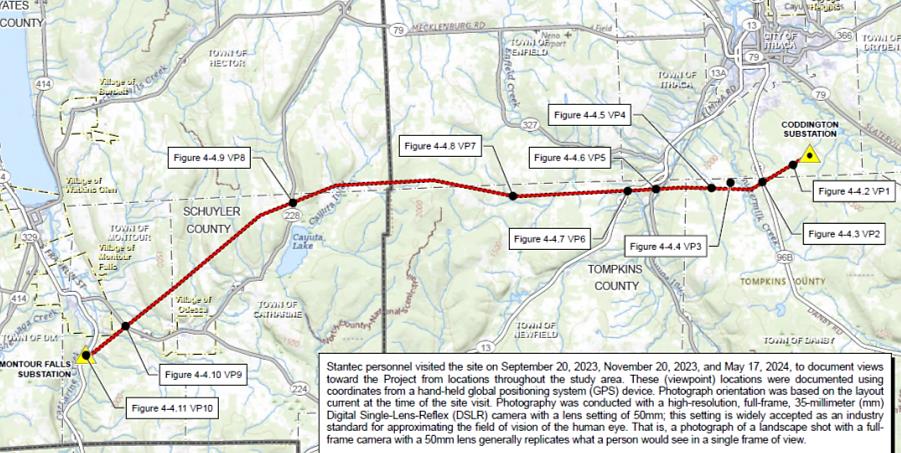
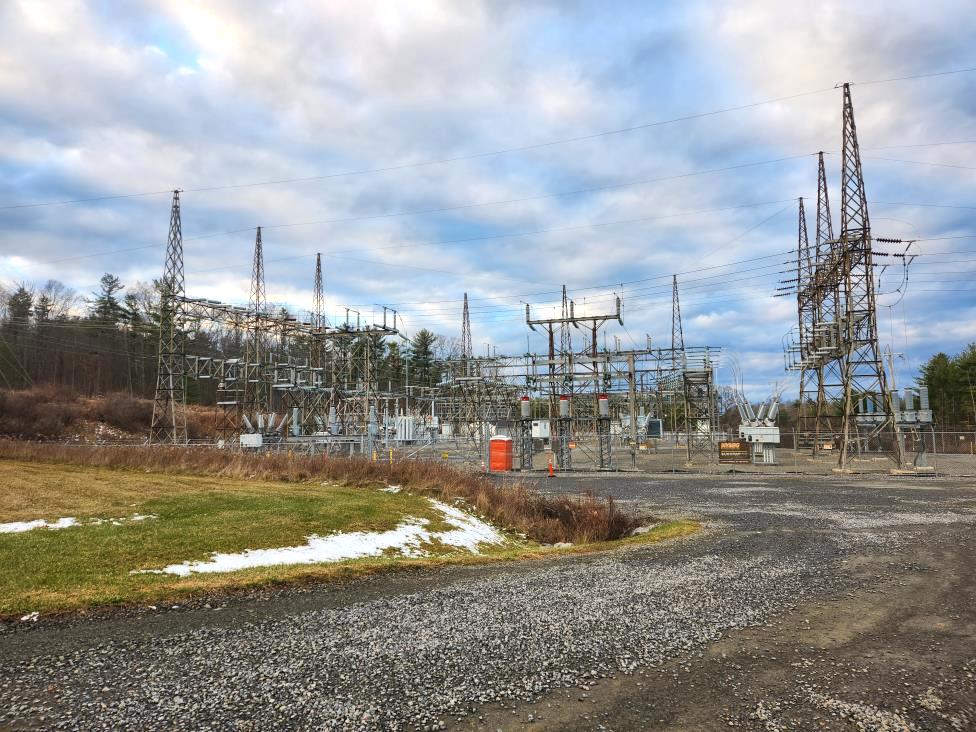
The “they” to whom Teeter referred is New York State Electric and Gas Corporation, NYSEG. And the “it” is NYSEG’s “FLAIR” project, the utility’s fast-tracked $88 Million rebuild of a 21-mile transmission line (#982) that links two large power substations, one in Montour Falls, and the other on Ithaca’s South Hill.
Pending grant of a “Certificate of Environmental Compatibility and Public Need,” an application now before the New York State Public Service Commission (PSC), the FLAIR endeavor would dismantle a long stretch of 91-year old, tandem wooden poles that drape their transmission conductors side-by-side within a 100-foot wide right-of-way. The current wires hang beneath an “H-frame” wooden configuration. NYSEG would replace the 1930-era H-frames with far-taller, brown, steel monopoles, supports that would attach wires to their sides.
Each gray wooden pole rises only 30 to 60 feet above ground. The steel monopoles, although fewer in number, would anchor in concrete and elevate from 74 to 122 feet. A NYSEG manager, speaking to Enfield officials, struck the average height at 88 feet.
“The existing line is over 91 years old and the asset condition is poor,” Emma Timerman, Project Manager for the FLAIR initiative, defended the replacement during a presentation to the Enfield Town Board November 12, a session that came one week after Enfield planners had given the company’s plans their initial look.
“These structures are made of wood and have been there for almost a century,” Timerman explained. “So you’ve got several generations of woodpeckers that have made their homes here.”
But a closer look readily confirms that our friendly, foreign-based utility has more on its mind than just deterring the unlikely prospect that poles will rot and drop their wires. Eighty-eight Million doesn’t get spent without a better purpose. The newly-rebuilt line would handle far more energy, NYSEG admits. The FLAIR cables would carry more than 2.5 times as much current of do the lines they would replace.
FLAIR would “remove bottlenecks to the local transmission system,” Timerman explained. “We’re trying to meet New York State energy goals, and we’ve got to put more power through these lines,” the manager advised the Enfield Town Board.

“FLAIR,” is an acronym probably conceived by some well-compensated, PR-savvy NYSEG marketing consultant. It stands for the “Finger Lakes Area Infrastructure Reliability” Project. PSC documents indicate that the utility first filed for the agency’s approval in December of last year. NYSEG’s timetable calls for a final PSC decision by the second quarter of 2026. Construction would start in early-2027, with the new lines completed and energized two years thereafter.
To their (supposed) credit, NYSEG and the PSC have purportedly fulfilled all legal obligations to notify municipal stakeholders, to post public notices, and to invite citizen comment. Nevertheless, the line replacement ingeniously for almost a year found a way to evade municipal and media scrutiny.
No news stories on FLAIR have yet found their way to the local press. An advisory letter that NYSEG supposedly provided to Enfield’s Town Supervisor last spring never got shared with other Town Board members or with constituents. The PSC held its obligatory Public Hearing October 8 in Montour Falls. The agency’s Administrative Law Judge kept the session open for half an hour that day, encouraging someone to speak. The hearing transcript reveals that no one offered testimony.
Only in November, slightly less than three months before the PSC’s January 29 deadline for written comments, did FLAIR generate serious public attention. And when it did, it certainly did.
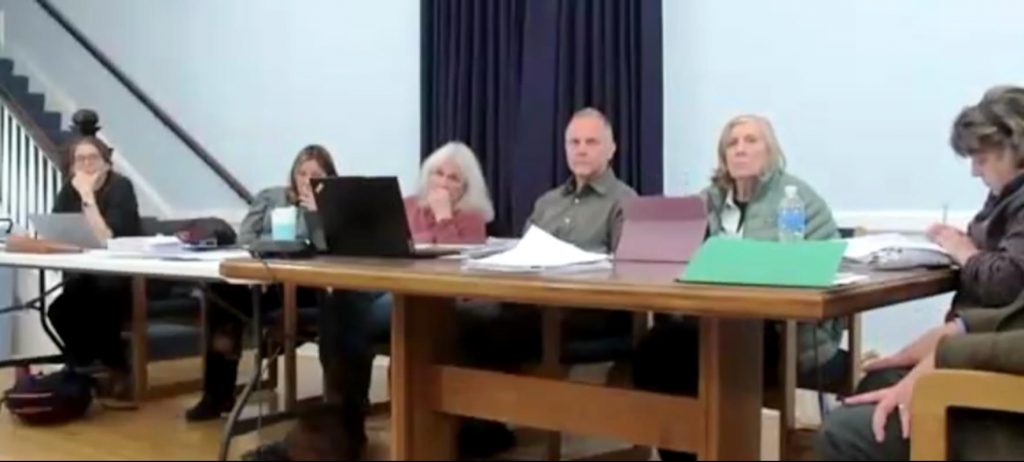
More than a dozen residents turned out for the Newfield Town Board’s monthly meeting November 20. Neighbors living near the NYSEG line and its right-of-way criticized FLAIR and ate up more than an hour of a session which Newfield customarily keeps succinct and to the point, but which this time dragged to until nearly Ten O’clock. Critics took frequent aim at the monopoles’ proposed height and how they might obstruct view of residents’ surroundings.
“I have one of the double wooden, electrical thingies in my backyard,” Cynthia Henderson of Millard Hill Road told the Newfield Board, Henderson referring to the poles standing there now, “which means it might end up being replaced by that gigantic monstrosity that they’re talking about putting up,” she surmised. “And it’s going to affect, possibly affect my property value and potentially cause some health issues. So, I’m quite against it, and I’m very concerned.”
“My whole life, I’ve dreamed of having my house on a hill with a scenic view,” 24-year old Kirsten Hamburg, a new homeowner on Douglas Road, informed the Town Board. “These aged poles were a concession for me, but I was fine with it because it blends in with the tree line. I cannot handle a ginormous pole in my backyard,” Hamburg complained.
“And I’m very concerned, because… I got no notice of this project,” Hamburg insisted. “I got no letter, I got no email. I got no phone call…. I did not get any notice of this project until I received a paper on my mother’s door last week that this is going on.”
That paper on the door was likely put there by Ann Brown or her son, Shaun. Mother and son spent days canvassing the neighborhoods of northern Newfield; knocking on doors, telling residents about the project, and leaving flyers if no one was at home. Credit the Browns not only for waking up those living near them, but also for first informing Enfield Board members of the incipient controversy.

“As you may or may not be aware, NYSEG is currently seeking Article VII approval for replacing their 115 kV transmission line (line 982) that runs from Montour Falls to south of Ithaca,” Shaun Brown emailed the Enfield Town Board on the first Sunday of November.
Concerning the nearly 100 foot monopole that NYSEG proposes, Brown critiqued. “A structure this tall is overkill for a 115kV transmission line, indicating that in years to come NYSEG will seek to increase the voltage and right-of-way.”
Three days after receiving Brown’s email, and at this Town Councilperson, Robert Lynch’s, request, the Enfield Planning Board took up the FLAIR project, yet issued no formal recommendation. One week later, the Enfield Town Board gave FLAIR its own look.
By a pair of 4-0 votes, the Enfield Town Board agreed to enter the ongoing PSC FLAIR deliberations as a “Party of Interest” and also to designate this Councilperson, Lynch, as its ”municipal representative and liaison” in the matter. On behalf of Enfield, electronic paperwork was filed November 17.
“I don’t think it does any harm,” this Councilperson advised the Town Board before it cast its final November vote. “I think it’s something we should do just to protect the Town of Enfield’s interests.”
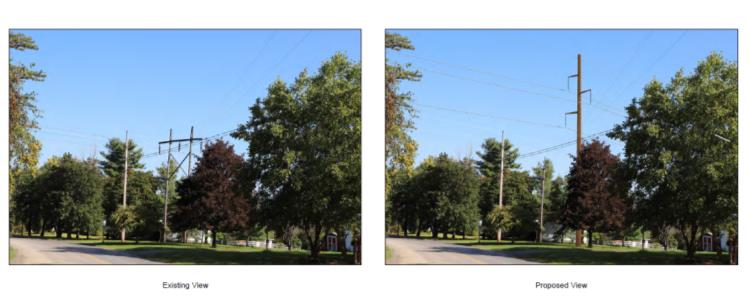
“This Town Board believes NYSEG in its PSC filings has failed to justify the need for this transmission line replacement,” Enfield’s adopted resolution to join negotiations stated, in part, adding “this Board believes that the higher metal structures FLAIR proposes would impose glaring visual impediments inconsistent with the text of… this Town’s Comprehensive Plan.”
The Enfield resolution also raised potential health hazards associated with electromagnetic energy, risks stemming from the increased current-carrying capacity of the new lines. Even though NYSEG submissions to the PSC purportedly affirm the company’s compliance with regulatory standards, the Enfield and Newfield discussions raised doubts, including about the safety of the line that already exists.
“I have in the past traveled that driveway under those 130 kilovolt lines,” a driveway leading to a constituent’s private residence, this Councilperson advised the Enfield Board in November. “And after I have done that and been at that residence for a while, I feel ill.”
“Being that proximate to it may be like standing in a microwave,” this writer related his sensation.
Joining the PSC review process does not obligate Enfield to file legal pleadings, retain counsel, or spend money, even though it could should it choose to do so. Instead, involvement will ensure that if NYSEG or anyone else pleads for or against the FLAIR project, Enfield officials will receive timely notice.
So far, the Newfield Town Board has not followed the same path. It has not formally joined the PSC proceeding. Yet Newfield Supervisor Michael Allinger signaled near the end of the November 20 meeting that Newfield will likely draft a formal comment, adopt it as a resolution, and forward it to the PSC by the agency’s late-January deadline.
Newfield has also announced plans for a second discussion of the FLAIR project at its next meeting, Thursday, December 11. NYSEG representatives will attend. Further Town Board action could follow.
That said, one’s actually stopping the FLAIR powerline replacement, although not impossible, could prove for any homeowner—or group of homeowners—a daunting challenge.

“I think it’s very unlikely that they’re going to stop this project,” Thomas Smith, Attorney for the Town of Newfield, advised during the November 20 meeting. “But I think that it’s also very unlikely that there’s not going to be a compensation element for landowners whose value is diminished as a result of the project.”
“So we lose,” one unidentified woman responded from the gallery in frustration.
Nevertheless, the prospect of landowner compensation could provide with it a small amount of solace. And for Supervisor Allinger, urging monetary rewards could become part of his town’s strategy.
“If we can draft a resolution of support to, for either compensation or movement of these structures so that they’re not obstructing any current easements, I’d like to make that one of three action items that we could possibly do,” Allinger told Board members. The Supervisor would also like more information through Tompkins County Government to help identify exact pole placement.
“So, on the one hand, I’m hearing from constituents all the time about why are we getting so many blackouts?” Allinger acknowledged. “And it’s because of the infrastructure. So the infrastructure’s clearly needed. Nobody’s going to argue that. But what can we do as a town to support the people that are going to be affected by these poles going up in their yard, even though they have the easements?”
Somebody, most likely a NYSEG representative and most likely at that Montour Falls public hearing (for which the official record is bare) described for Newfield’s Ann Brown the FLAIR right-of-way as just “Billy Goat Country.” For those who tossed that comment around the room November 20, it didn’t sit well.
“And I took offense to that, because Newfield’s not Billy Goat Country,” Ann Brown protested. “We are prospering; we have seen real estate come in, new houses being built. On my road alone, there are two new businesses.”
“It’s important that it’s not Billy Goat Country,” Cynthia Henderson concurred. “Really, it is beautiful out here, and I love my neighbors. “
Sunny View Drive’s Carolyn Clark added, “But we’re not a Billy Goat trail, with people coming from all other parts of the world to a very beautiful place. We want to keep it that way.”
Whether or not Billy goats wander that 21-mile, 100-foot wide right-of-way west from the Coddington Substation on Ithaca’s East King Road to Montour Falls remains an open question. But that a lot of angry people live along that corridor too remains far more certain. In Enfield, it’s only a residence or two, plus Rich Teeter’s Teets and Son scrap yard that intrude close to the lines. But in Newfield, many more live within sight of them. People have grown accustomed to what’s there now. They fear what lies ahead.
“So, where are they gonna put this monstrous power pole? James Martin, owner of land he hopes to build upon at 306 Millard Hill Road, asked. “What is it going to do to our, our view of, you know, city lights, our coming out and looking at stars?” Martin continued to question, “And you’re considering people coming to camp with us, you know, building a house. Where we want to put our home is, could be greatly impacted, and maybe not even possible should that large power pole exist.”
And, of course, there’s always a second shoe that could drop. What if once NYSEG built the higher, more hefty line, it added a second trio of wires or another string of those ugly metal monopoles? What if the visual blight and the electromagnetic danger were compounded? That question came up in Enfield.
“Could it put additional poles to either side of that that’s being proposed now to increase the carrying capacity in that right-of-way?” this Councilperson asked NYSEG’s Timerman at the November 12 meeting.
“Potentially?” Timerman responded hesitantly, apparently caught off guard. “This is my project. I can’t say in the future. Maybe?”
And that perceived evasiveness; that “never-mind, we’re NYSEG” attitude bothers more than just one of us.
“I love my property. I love where I live. I pinch myself every day that this is like a vacation home with my views,” Margaret Hamburg of Douglas Road told the Newfield meeting. Of the monopoles, she evaluated, “It’s gonna, it’s very devastating for us, 100%.”
And of how this has all come down, Hamburg’s opinion: “I think it’s been very sneaky on NYSEG. It’s been, it’s been backdoor.”
###
Posted Previously:
News Desert Defiance
Tompkins Legislature “cancels” The Ithaca Journal; adopts ’26 budget
By Robert Lynch; November 21, 2025
Times change. But laws sometimes do not. And because of an archaic state statute likely kept in place only by lobbyists, the Tompkins County Legislature may need to eat its defiant words of Tuesday night and designate The Ithaca Journal as its official newspaper again for next year.
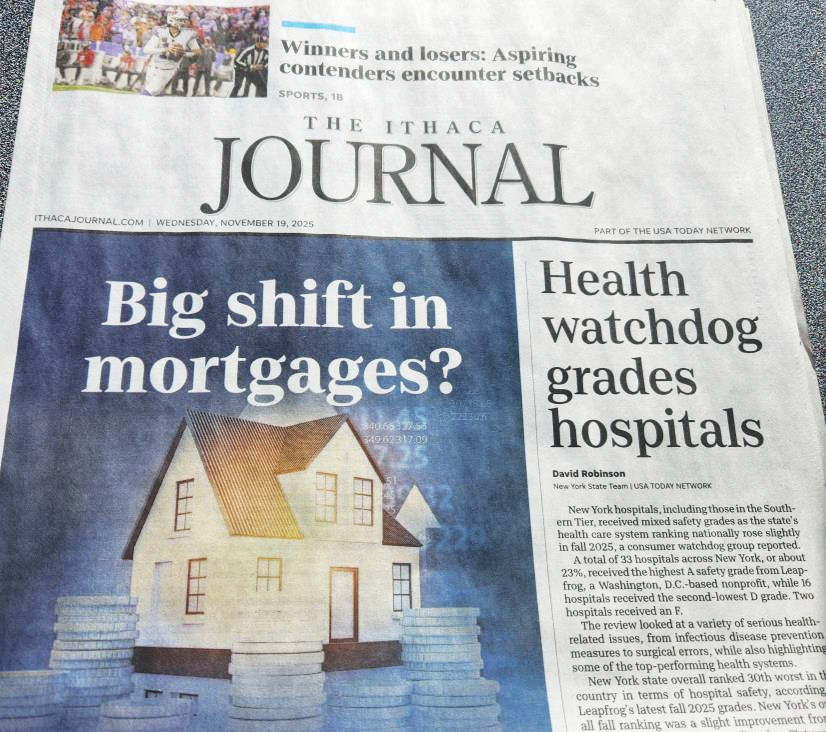
Any such renewal would come only grudgingly. And November 18, it didn’t come at all. With only two in support and 12 opposed, the County Legislature denied the Gannett daily its perennial perch, a privilege that carries with it the paper’s unchallenged right to take taxpayer money for publishing legal notices at whatever price it sets.
Additionally at the mid-November meeting, the Legislature revised and then adopted its 2026 County Budget. It also debated, but then delayed action on whether to request from New York State a one percent increase in its Hotel Occupancy Tax.
In voting down The Journal’s designation, Tompkins legislators followed through on a threat they’d made in years past, yet never quite found the courage to invoke. Choosing a newspaper normally becomes perfunctory housekeeping. But as they cast The Journal aside Tuesday night, lawmakers complained about the shrinking tabloid’s dwindling subscriber base, its inflated price, and impliedly its lack of local reporting.
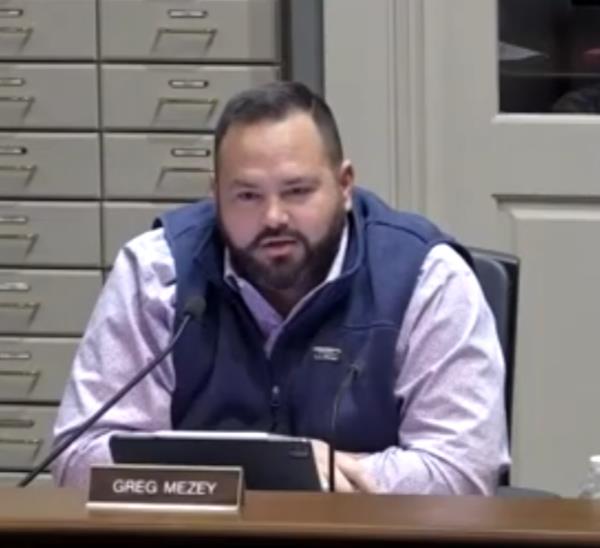
“I think we all understand our right to protest,” Dryden’s Greg Mezey, leader of Tuesday’s anti-Journal rebellion, made clear. “I think sometimes as a lower level of government, we need to rise up and use our voice and our platform to encourage the state to move more swiftly.”
Where Mezey would like Albany to swiftly run is to amend its laws so as to permit local governments to publish legal notices in online news outlets like The Ithaca Voice, or in print-internet hybrids like Tompkins Weekly or The Ithaca Times.
Current New York rules forbid such freedom. Statutory definitions confine official newspapers to daily publications of general circulation published within the community. By that standard, only The Ithaca Journal qualifies here.
And in legislators’ eyes, that paper squanders its monopolistic privilege; taking advertising dollars and giving nothing in return. The Ithaca Journal may still have an Ithaca newsroom, but there’s seldom anyone there. The paper is now edited and printed in Johnson City, as are other Gannett papers serving the region. Journal reporters long ago stopped covering local politics, including meetings of the Tompkins County Legislature.
The legacy paper’s enviable status rankles Matt Butler, Editor-in-Chief of The Ithaca Voice. Butler took the mic during floor privileges at Tuesday’s meeting and urged lawmakers to consider his employer’s struggling digital platform as a better choice.
“Every organization in Tompkins County is doing more for local news than Gannett is through The Ithaca Journal,” Butler insisted. “I don’t think that it’s appropriate or smart to keep sending Gannett money just to pay rent on an empty office, or more likely honestly to just reallocate the money elsewhere where they deem the news more important for people to receive.”
Numbers tell the story. And they tell a story of The Ithaca Journal’s tumble from dominance. In 2017, the paper, then well on its retreat, had 8,809 subscribers, Mezey reported. That number has since shrunk to under 2,000, Legislature Chair Dan Klein said he’d learned.
Meanwhile, The Ithaca Voice, legislators were told, receives far more local hits. It gets 400,000 site visits per month, boasts more than 7,300 daily newsletter subscribers, and reportedly had 1.1 million active visits between January and September of this year.
The Ithaca Voice is free. But The Ithaca Journal’s getting pricy. Emaciated as it is, the daily paper costs $2.00 a copy. Teaser rates aside, print and online combination subscriptions can cost more than $90 per month, legislators were told. That can approach or surpass $1,000 in a year.
“If we want to talk about how we get our message and our publications and our notices out to the largest possible audience, this is the way,” Mezey asserted, praising a digital alternative. “An antiquated method of print news that doesn’t care about our community, is not the way to do that,” Mezey stated.
“The point of a public notice is actually to spread the word, to make the public aware of something,” Butler reminded lawmakers. Those needing to be informed are “not going to the publication for the public notices,” he reasoned. “They’re going there for the local news, and if that publication isn’t providing local news, there’s not going to be anyone there.”
But the law is an ass, they say. And despite best efforts locally, nobody seems capable of convincing state legislators to revise a section of the nit-picky “General Construction Law” that mandates governments post legal notices using the time-honored permanence of printer’s ink emplaced upon something perhaps perused today, yet tomorrow employed to wrap fish.
“This is just a leftover linguistic appendage,” Mezey said of the law’s decaying dictate. “It’s just hanging out there, and it should be cut out at the root, and we need to think differently how we notify our public, because this is not the way,” Mezey said of what the state insists always need be done.
After Mezey spoke those words, Mike Sigler clanged his drinking glass from across the room. It rang like a cowbell. The Lansing Republican, who sells billboard advertising for a living, has been railing against—and voting against—The Journal’s privileged designation year after year.
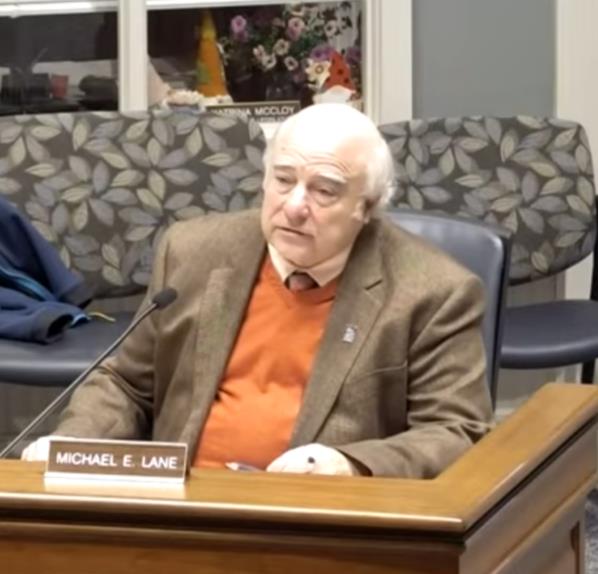
Dryden’s Mike Lane has also complained in the past about how low Ithaca’s once-great newspaper has sunk. Although he voted against official designation in committee, Lane joined Legislature Chair Klein to support the resolution in Tuesday’s final vote. Lane cautioned his was only a “reluctant yes.”
“I think we have to have a paper whether we like it or not, for now,” Lane counseled.
The Legislature’s Clerk, Katrina McCloy, concurred. She said the Secretary of State demands she notify his office of the designation by year’s end.
Two years ago when it tackled newspaper affirmation, the Tompkins County Legislature coupled its designation with unanimous endorsement of a then-proposed state resolution that would have broadened publication options to include certain online outlets under tightly-defined rules.
“These bills would permit this body to publish notices with other local newspapers with an online presence, increasing access to public information and supporting more local journalism,” the locally-passed legislative endorsement stated.
Yet even on the night the local legislature passed its 2023 recommendation, the sponsoring committee’s chair conceded defeat. According to the meeting’s minutes, Assemblymember Anna Kelles had advised the committee chair that “the resolution was determined to be not moving forward.” Later reporting would suggest that intense pressure from the print industry had spiked the reform initiative.
A January 2024 recommendation by the Enfield Town Board had urged similar reform. The online option “would likely save the Town considerable resources and provide the Town Clerk added flexibility in scheduling those notices’ publication,” the Enfield recommendation had stated.
In the nearly two years since then, Albany leaders have done nothing further to anyone’s knowledge.
So to remain legal, expect the Tompkins County Legislature at its next meeting in December to resurrect the issue, re-designate The Journal, but also accompany its action with an emphatic pleading Greg Mezey plans to write.
We need to “send a very strong letter to our state representatives and demand action on their part because it’s unacceptable,” Mezey stated in deriding the status quo.
Among other business, a final 2026 Tompkins County Budget emerged from the November 18 meeting. The Legislature adopted it unanimously, the first time that’s happened in years.
Most often, the final budget vote warrants only a footnote, since legislators have already performed most of their heavy lifting during a long string of budget meetings that begin shortly after Labor Day.
Yet last Tuesday’s final tinkering proved more extensive than usual. Adjustments consumed more than an hour of debate and a series of votes. And while the changes ticked up the tax levy a bit, they still contained that levy within the calculated 3.59 percent New York State-recommended tax cap.
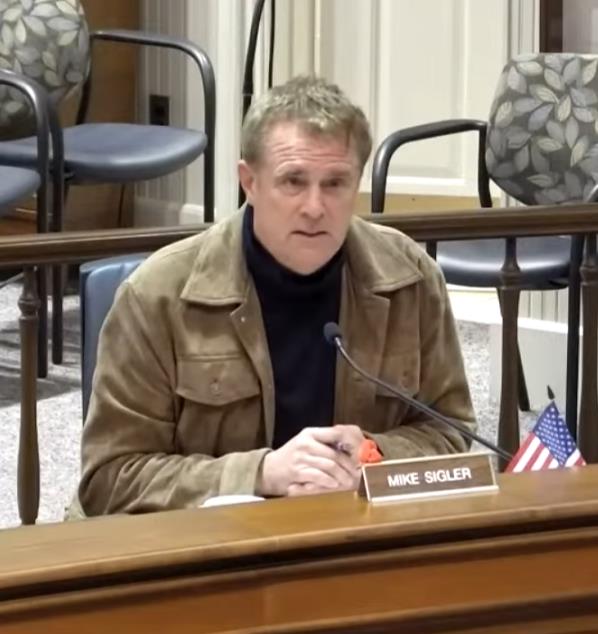
“I’m not a big fan of this budget,” Lansing’s Mike Sigler conceded, because “the taxes go up,” he said. But “this to me is a bit of reckoning for us,” he added, “because assessments for a long time have floated us as a county, and it seems that this year that has not happened, and I don’t expect that will happen going forward.”
“Things cost more, and that’s the reality,” Greg Mezey acknowledged. In some years, Mezey votes against the budget. This year he supported it.
“I believe that this budget balances the most urgent needs of our residents and sustains the vital services whether it’s above or below the tax cap, and as it is I will support it,” Groton’s Lee Shurtleff stated.
In their final-meeting juggling of budget numbers, legislators cut to $280,000 an earlier-planned half-Million dollar subsidy to Tompkins Consolidated Area Transit (TCAT). The reduction followed Cornell University’s late decision to fund an equal $280,000 TCAT subsidy compared to the meager $31,000 Cornell had first proposed.
But for Tompkins County, those budget savings became short-lived. In a series of votes, legislators allocated $191,550 to support a trio of programs. One of the appropriations directs $58,590 into OAR (Opportunities, Alternatives, and Resources), an agency assisting the formerly incarcerated. OAR beneficiaries’ passionate appeals dominated a September 30 County Budget Forum. Another last-minute appropriation will support a program to provide mammograms to low income Ithaca residents.
And in a final move that pushed up the levy to match the tax cap, lawmakers funneled another $150,000 into their contingent fund. The levy increase as the meeting started was 3.37 percent. By meeting’s end, the levy was up nearly 3.6 percent.
Left for another day—if it ever survives that long—is a controversial initiative to raise Tompkins County’s Hotel Room Occupancy Tax from five to six percent. The idea would require state legislative approval next year. The hotel tax request had drawn divided votes in two local legislative committees, having failed in one of them. And after heated debate Tuesday, the full Legislature sent the idea back to committee where it could very likely die.
“Our visitor data is showing that our visitation is down,” Peggy Coleman, President of the Tompkins County Chamber of Commerce, cautioned legislators at the meeting’s start. International visitation year-to-year is down by 52 percent. The Canadian portion of that metric is down a full 72 percent.
“From a leisure travel perspective, this is really not a good time to increase taxes to create more expense to folks as they’re trying to manage the expenses of everything else in their lives,” Coleman warned.
But some on the Legislature, including Lansing’s Mike Sigler, Dryden’s Mike Lane, and Newfield-Enfield’s Randy Brown, would target the projected $800,000 in newfound revenue from the one percent increase to shore up revenues at the Ithaca-Tompkins Airport. The local airport struggled—and failed—in this most recent budget cycle to win increased taxpayer subsidies that might hold enplanement fees down and entice new airlines to establish routes here.
“We have very few opportunities to increase revenues,” Brown said. “And I think this is something that would help regular taxpayers here.”
“This is our version of Saturday parking,” Greg Mezey countered, the Dryden lawmaker taking a snarky swipe at the City of Ithaca’s recent moves of desperation to fill a seven-figure budget gap. “Let’s throw something at the wall, and maybe we’ll figure it out later,” Mezey sarcastically told colleagues.
“I absolutely do not support this,” Mezey continued, blasting the hotel tax proposal. “We have absolutely no plan for this money; absolutely no plan for this money! Why would we levy a tax with no plan?” Mezey stridently asked.
True, for our county merely to request permission from the state would not necessarily compel the tax’s later imposition, lawmakers were advised. Yet some would prefer Tompkins County ditch the idea here and now.
“Regardless of what the reasons are for the decline in our tourism, there is a principle that when you’re in a hole, you don’t keep digging,” Deborah Dawson advised. “And to make it more expensive to come here when people aren’t coming here,” Dawson said, “is the equivalent to me of digging.”
The hotel room tax measure went back to committee by a nine-to-five vote. Whether it will ever exit that committee and return to the legislative floor, only time will tell.
###
Fossil fuel heating ban on hold as Enfield Board speaks out
by Robert Lynch; November 14, 2025
Governor Kathy Hochul didn’t want to do it. But the courts gave her little choice. A gubernatorial-backed New York law and building code update that would ban the installation of fossil fuel-fired furnaces and gas cooking stoves in most new Empire State homes won’t take effect New Year’s Eve as Hochul and state lawmakers had hoped.

Attorneys for the Governor’s Department of State and industry plaintiffs who’d challenged the New York prohibition entered a stipulation Wednesday in Federal District Court suspending the New York prohibition pending appeal of a federal lawsuit.
The stipulation would likely postpone implementation of New York’s All Electric Buildings Act well into 2026, if not longer.
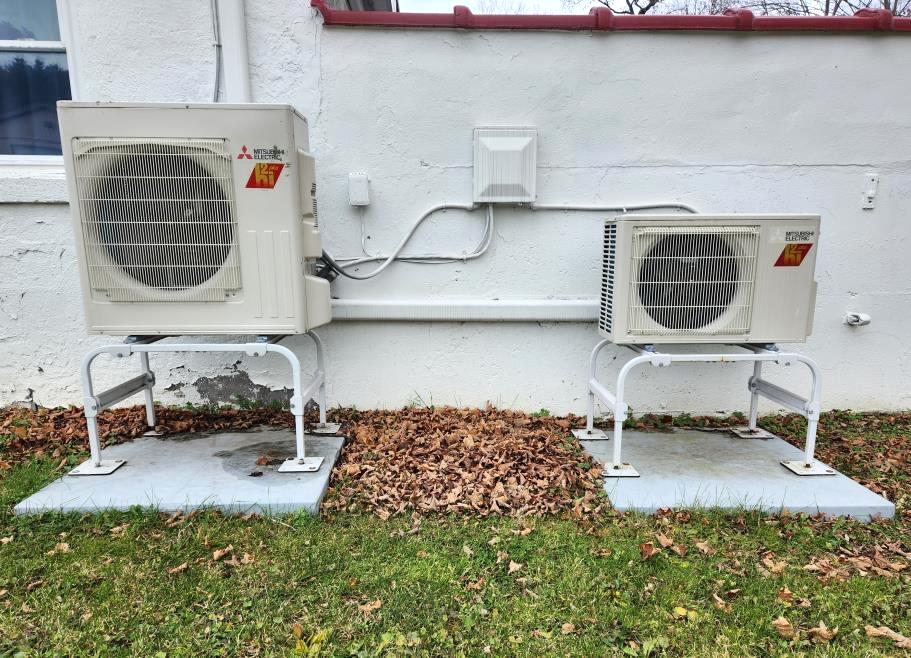
Meanwhile, unrelated to the pending litigation, the Enfield Town Board, during its meeting October 22, adopted a resolution urging Hochul to delay the law’s implementation on grounds that the local electric grid lacks capacity to handle the load a rapid transition to heat pump technology would require.
“The Enfield Town Board welcomes the intelligent, aspirational transition to renewable energy sources for home heating and associated energy applications, yet also recognizes the infrastructure limitations that currently impede total electrification efforts in rural communities such as its own,” the Town Board’s request for a gubernatorial intervention stated.
Enfield’s late-October action—taken at a session otherwise called to hear public testimony and vote on the Town’s 2026 Budget— followed an initiative advanced earlier that month by a Cortland County community to thwart the all-electric heating and cooking mandate.
The Cincinnatus Town Board’s resolution took a different path than did Enfield’s. Cincinnatus supported a federal bill that would override New York’s mandate. Enfield lawmakers chose not to embrace the Republican-sponsored federal legislation.
“I’m not going to give up my gas stove,” Gray Road’s Cortney Bailey asserted during floor privileges at the start of the Enfield Board’s October 22 meeting. ”At least when the power goes out for five days when my son was five or six, I could still cook without having power. (Bailey’s son is now grown.)
As for the All Electric Buildings Act, “I think that’s very harmful for our area,” Bailey said. “I honestly think that they’re thinking everybody lives in the damned city.”
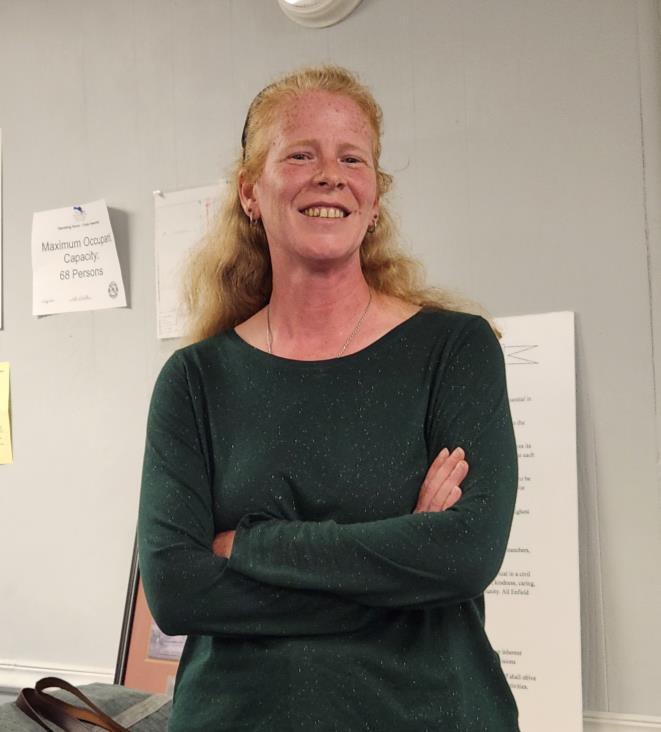
“There’s been a lot of talk about this, and it’s scary,” this writer, Councilperson Robert Lynch, author of the Enfield resolution, advised the Town Board that night. “I’m all for heat pumps; we have them in this building,” he said of the Enfield Courthouse, where the Town Board meets. “And if people want them, that’s fine, but I don’t think we should force people to have them.”
The All Electric Buildings Act, long-sought by New York’s environmental activists, was one of those measures snuck into a mammoth budget authorization bill in the spring of 2023, a bill so big that footnotes that chip away at personal freedom become hard to spot and evade the news cycle.
Under what’s now Section 11-104 of the New York Energy Law’s “Energy Conservation Construction Code,” the 2023 law advises us that “to support the goal of zero on-site greenhouse gas emissions and help achieve the state’s clean energy and climate agenda… the code shall prohibit the installation of fossil-fuel equipment and building systems, in any new building not more than seven stories in height… on or after December thirty-first, two thousand twenty-five.”
The seven-story threshold would, of course, conveniently carve out a temporary waiver for developers of commercial high-rises. Builders of large commercial and industrial buildings gained a similar reprieve. Yet the code would nonetheless require all newly-built structures, either tall or short, large or small, to comply with the fossil-free mandate beginning in 2029.
As currently enacted, the All Electric Buildings Act would affect only new construction, not existing homes or commercial buildings. Yet some fear regulatory creep: Once the camel of the nanny state gets its head inside the tent of your basement or kitchen, some among us worry runaway regulation could extend itself downward to homeowner replacement furnaces and range-tops as well.
As always, what Albany legislators and their green-building allies find so easy to enact in the dead of a legislative night years ahead of a deadline can come back to bite them when that deadline actually looms large. To that point, media reports indicate that as many as nine moderate Assembly Democrats had signed a letter in October asking Governor Hochul to roll back the statewide mandate. Hochul remains adamant that the new law take hold as soon as legally possible.
But it was the courts, not legislators that succeeded in imposing this latest postponement.
In October 2023, the National Association of Home Builders, the National Propane Gas Association, and various energy and construction trade groups banded together and sued the state in federal court. The petitioners, including current lead plaintiff, Mulhern Gas Company, Inc., claimed that New York State had overstepped the bounds of federal authority when Albany unilaterally imposed the fossil fuel construction ban. The plaintiffs claimed federal statute pre-empts the state’s actions.

The federal district court for the Northern District of New York upheld New York’s new codes last July 23. But the plaintiffs appealed their case to the United States Court of Appeals, Second Circuit. The parties’ stipulation of November 12 stays imposition of the fossil fuel building ban until the Second Circuit can rule on the appeal. And it would extend the stay for 120 additional days beyond the decision.
Whichever side lost the appeal could then petition further to the U.S. Supreme Court. And the stay would similarly block implementation until after the High Court rendered its decision.
Had the parties not agreed to delay the law’s effective date, the district court would have acted on the petitioners’ motion to enjoin New York from implementing key portions of its Energy Law.
In accepting the stipulation and delaying implementation, plaintiffs and the state made clear that this is an action dictated by procedure, not substance.
“The stipulation and order shall not in any manner be construed as determinative of the issues or claims raised in this action or any other proceeding of any kind and shall have no precedential value,” the latest court filing stated.
Appeals take time. They can take a long time. If Mulhern v. Mosley—Walter Mosley is New York’s Secretary of State—were to go all the way to the Supreme Court, one could see the All Electric Buildings Act being sidelined well into 2027.
Contacted by reporters, a spokesperson for Governor Hochul expressed disappointment that the ban on new fossil fuel installations won’t take effect this New Year’s Eve, as was planned.
“The Governor remains committed to the all-electric-buildings law and believes this action will help the State defend it, as well as reduce regulatory uncertainty for developers during this period of litigation,” Ken Lovett, the governor’s senior communications advisor for energy and environment, emailed multiple news outlets concerning the appeal. “Governor Hochul remains resolved to providing more affordable, reliable, and sustainable energy for New Yorkers,” Lovett added.
Yet some environmental activists and their legislative allies have cried foul, maintaining in recent days that the governor’s latest action reflects a softening of her environmental policy; the third of three recent walk-backs, one of them paving the way toward crypto mining on Seneca Lake.
In urging Governor Hochul to wield her executive power and delay the heat pump-friendly laws until electric grids can handle the load and homebuilders can fathom the curtailment of their liberty, the Enfield Town Board last month walked somewhat cautiously. The Town Board urged regulatory restraint, yet jettisoned a portion of a draft resolution that would have endorsed a Republican Congressional initiative, named the “Energy Choice Act.” It’s a bill that would pre-empt New York’s prohibition more broadly.
The Energy Choice Act is the brainchild of New York representative Nick Langworthy and West Virginia Senator Jim Justice. Congressman Langworthy represents much of the western Southern Tier and south Buffalo regions that Ithaca’s former Congressman, Tom Reed, once represented.
Whereas the Mulhern group of plaintiffs must argue in court a case of federal preemption that’s ambiguous and nuanced, the Langworthy-Justice legislation imposes a firmer hand:
“A State or local government, or instrumentality or regulatory agency thereof, may not adopt, implement, or enforce a law, regulation, ordinance, building code, standard, or policy that prohibits or limits, or has the effect of directly or indirectly prohibiting or limiting the connection, reconnection, modification, installation, transportation, distribution, expansion, or access to an energy service based on the type or source of energy that is sold in interstate commerce to be delivered to an end-user of such energy service,” Congressman Langworthy’s bill would unapologetically order. Senator Justice’s bill carries identical language.
“I’m generally OK with this,” Councilperson Jude Lemke said of the initially-drafted Enfield resolution, “but I’m not OK with the provisions of the Energy Choice Act,” Lemke added. “It’s very broad, and I’m not sure that it is a good idea.”
Endorsement of the Langworthy-Justice bill was the cornerstone of the Cincinnatus Town Board’s October 14 resolution, passed unanimously, that launched the opening salvo of municipal resistance to the All Electric Buildings Act. The Cortland County town’s resolution gained statewide attention. It prompted Enfield to follow suit.
“The Town Board urges Congress to pass the Energy Choice Act to defend consumer choice, protect energy affordability, and preserve reliable access to natural gas for all New Yorkers,” the Cincinnatus resolution stated.

Following Cincinnatus’ lead, this Enfield Councilperson, Robert Lynch, drew upon its language in drafting Enfield’s “Resolution to Support Freedom of Homeowner Energy Choice.” To gain unanimous support from others, this Councilperson deleted the paragraph to which Lemke objected, the federal bill’s endorsement. Instead, the Enfield board inserted a sentence that Lemke had recommended:
“Resolved, that this Town Board urges Governor Hochul and the New York State Legislature to develop policies that result in diverse sources of energy to help residents obtain cost effective energy while continuing to expand renewable energy sources within the State over time,” Councilperson Lemke’s amendment stated.
But despite deference to compromise, the local resolution remained adamant that “the Enfield Town Board urges Governor Hochul to exercise her executive authority to whatever extent permissible and suspend the impending implementation of the New York State Energy Code’s prohibitions on the installation of fossil fuel equipment and building systems for new construction, prohibitions that would otherwise take effect on December 31, 2025.”
“I get calls in the 24 hours of the power going out,” Enfield Supervisor Stephanie Redmond told the Town Board at the October meeting, speaking as the board headed toward a vote. “People are desperate,” Redmond reported, “and I always urge people to have backup for their backup for their backup.” The Supervisor said she urges residents have a backup generator, backup heat, and a wood stove.
Stephanie Redmond, by choice, lives in a home off-grid.
The Cincinnatus resolution scripted its advocacy on the presumptive ability of new homeowners to tap into natural gas. But not one natural gas pipe intrudes into Enfield. And none may ever do so should the All Electric Buildings Act eventually take effect.
Indeed that lack of available cheap gas may stand in part to blame for Enfield’s stagnant economic growth. Town Planning Board Chair Dan Walker earlier last month informed the Town Board that new subdivision applications in Enfield this year have virtually ground to a halt.
“We could have a lot more expansion if somebody would extend a natural gas line into Enfield, but nobody has yet,” this Councilperson advised. “It’s not necessarily the future, but it would help our growth.”
“Let them know this is a really bad idea,” Cortney Bailey reflected on the state law as the Town Board sent its Freedom of Homeowner Energy Choice message on to Albany for Hochul or whoever else to read.
“We might be smaller in number than the people who live in cities,” Bailey said of herself and her rural neighbors, “but we’re still here, and we should not have to meet such outrageous demands when they (the leaders in Albany) can’t even make sure that we can have power consistently all the time.”
“I’m not putting electric baseboard heaters in,” Bailey insisted. “That is insanity.”
###
Tompkins funds downtown demo amid secrecy and rising costs
$2.6 Million spent to deconstruct buildings after long, closed meeting
“I feel like this is a runaway train at this point.”
Tompkins County Legislator Shawna Black, on the Center of Government, Nov. 4.
by Robert Lynch; November 7, 2025; Updated November 11, 2025
An Update to this Story:
On Monday, November 10, Tompkins County Legislator Randy Brown, Chair of the Legislature’s Downtown Facilities Special Committee, released the following statement in response to this writer’s inquiry asking him to explain his position on deconstruction of existing buildings on the Downtown Center of Government site and the lengthy executive session held by the Legislature November 6 as well as a similar executive session held two days earlier by the committee Brown chairs.
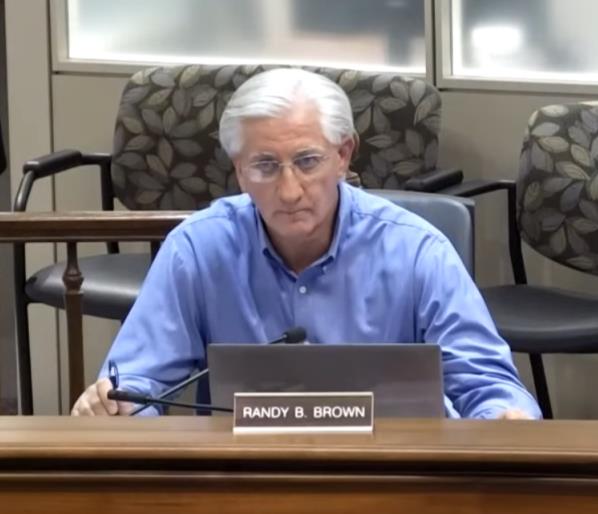
Likely bound by secrecy, Brown did not discuss publicly the Legislature’s executive session. But he did indicate the legality of the committee’s closed discussions were approved in advance by the County Attorney and were held to receive Holt Architects’ assessment of the project’s cost.
As for the Center of Government project itself, Legislator Randy Brown stated:
“The County has taken many steps over the years to construct a building downtown that would house up to fifteen departments. This building would be over 50,000 square feet, and the project would include renovations to two buildings owned by the County located on Court Street.
“Earlier this year the County approved $50,000,000 for the entire project and we are now hearing the cost will exceed this number. I am not in favor of spending this amount of money when other less expensive options are available. One option should be a smaller building based on actual need.
“I also believe the County has building spaces that are underutilized that would provide better access to constituents.
“I will be working with County Administration to consider other options seriously and completely. The County has many future costs we must consider before spending taxpayer funds on this project and the impact to the tax levy must be recognized.”
Randy Brown joined all other legislators November 6 in authorizing funding for deconstruction of existing buildings on the Center of Government site. / RL
****
Now, the original story:
Transparency involving the Tompkins County Center of Government took another hit Thursday night. And it did so as County legislators admitted that tearing down three of the buildings on the center’s site will cost almost as much as did buying two of them.
In a unanimous vote preceded by zero public debate November 6, the Tompkins County Legislature authorized the County’s Facilities Department to spend up to $2.6 Million to “deconstruct” three buildings standing in the project’s path. To come down are the former Key Bank branch at East Buffalo and North Tioga Streets; the vacated multi-attorney “Professional Building,” located next to it on North Tioga; and “Building C,” the Board of Elections and Assessment office, situated on the former bank’s Buffalo Street side.
But the Legislature’s late-night action came only after a closed executive session that stretched on for more than an hour and a half.
All three downtown structures would need to come down to clear the land for the planned four-story Center of Government, an increasingly expensive, consolidated office complex that would rise up adjacent to the Courthouse. Most recent figures have priced the project at $50 Million. But based on new estimates, that cost is now expected to jump by multiples of millions.
After a prior series of many closed-door meetings earlier this decade, Tompkins County bought the Key Bank and the Professional Building in the fall of 2021 for a combined nearly $3 Million. Building C has been owned by Tompkins County for more than a half-century. It was once the TV studio for Ithaca College.
Earlier Thursday, in a written report to local municipal officials, one read during a monthly conference call, County Administration, through its Communications Director, claimed that at a legislative committee meeting two days earlier, and as part of a report by architects, “it was reported that the overall project cost is currently estimated to be approximately $14 million higher than the original projection.”
The problem is, architects never made such a statement, at least not during the committee’s public portion. The only overall project pricing talk occurred as an aside comment by one legislator to another, a comment suggesting that total cost had risen to $60 Million.
What is the current estimate, legislator Shawna Black asked her colleague Deborah Dawson, sitting beside her that day.
It was “30 to 40,” and now we’re at 60,” Dawson answered.
Actually Deborah Dawson had started low. When former County Administrator Jason Molino in 2019 had revived the Center of Government concept, albeit on a different site, he’d pegged the project at $20 Million or less.
Ever since taking office in January, the current County Administrator, Korsah Akumfi, has pressed forward toward approving the newly-costlier project. His efforts led to a quasi-binding commitment to proceed, approved by legislators in June. By necessity, all plans include old building deconstruction.
Akumfi attended Thursday’s meeting only remotely, and he spoke little about the project at that time. But the narratve County Administration presented municipal leaders in writing earlier that day was likely of Akumfi’s crafting.
Of the $14 Million estimated cost escalation, Administration wrote municipal leaders, “The County is reviewing these updated cost estimates to determine potential adjustments to the project scope, timeline, or financing strategy.”
“As of now, the County’s Center of Government initiative continues to advance unless there is a resolution from the Legislature to change direction in any way,” the Administration’s narrative, read by the communications staffer, continued. “While the updated cost estimate presents obviously new fiscal considerations, County Administration and Facilities continue to move forward to ensure a successful implementation of this project,” the message stated.
When the deconstruction resolution reached the Legislature floor Thursday night, members made it clear they’d prefer evaluating the Center of Government’s future in private.
Even the text of Thursday’s adopted resolution was kept secret from online attendees prior to and during the meeting. The resolution was hidden in the so-called “red folders” that only legislators and staff can access in advance. No committee had publicly vetted the measure. The resolution’s text was not recited on the floor. And before its adoption, sponsor Randy Brown referred to the resolution only by its title, “Approval of Funding for Deconstruction of Buildings.”
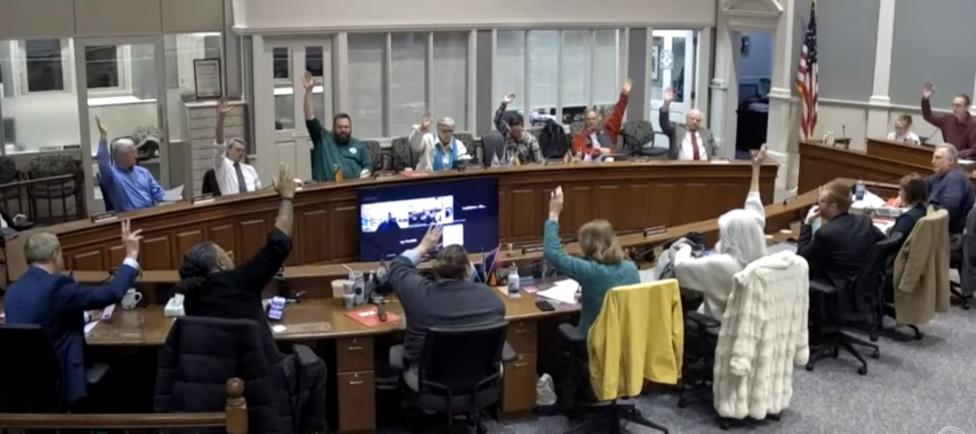
After the measure was moved and seconded following the executive session’s end, Legislature Chair Dan Klein asked for discussion. No one spoke. And after a momentary pause, Klein called for a vote. All hands shot up in support. Business concluded, the Legislature promptly adjourned.
The resolution’s contents were only made known after a legislative clerk had handed this writer, at his request, a copy of the draft document through the legislative chambers’ door late Friday morning.
After being contacted Friday afternoon and asked why the need to deliberate the resolution in private, legislator Brown had not responded prior to the posting of this story.
The latest wrinkle elevating the Center of Government’s deconstruction cost is a familiar one in these sorts of projects, asbestos removal. And the problem child among the three structures doomed for destruction is Building C, the Elections and Assessment office.
“The exterior has friable asbestos in the stucco,” Arel LeMaro, Tompkins County Facilities Director, advised the Downtown Facilities Special Committee November 4, the committee chaired by Newfield-Enfield’s Brown, the lawmaker who brought the deconstruction measure to the full Legislature Thursday.
The stucco’s been crumbling off Building C for years. But until a recent engineering review, nobody knew it contained asbestos. Because of that newfound danger, scaffolds must be erected, plastic tents put in place, monitors installed, and special removal procedures employed.
Largely because of Building C’s precautions, LeMaro and lead architect Quay Thompson estimated Tuesday that “abatement” expenses would contribute $1.3 Million toward the projected $2.5 Million cost to deconstruct all three buildings.
And no, LeMaro said, Tompkins County cannot stretch the rules as a private developer did earlier this decade when it tore down another asbestos-laden building, the Old County Library. It did so while still keeping “asbestos in place.”
The Old Library was supposedly different, LeMaro explained. The housing developer that bought the building secured a variance, perhaps on questionable grounds, maintaining that the library’s roof was falling in and that the building should be condemned. “These buildings are not condemnable,” Facilities Director LeMaro pointed out with the Buffalo and Tioga Street trio. Grounds for condemnation just don’t exist, he said.
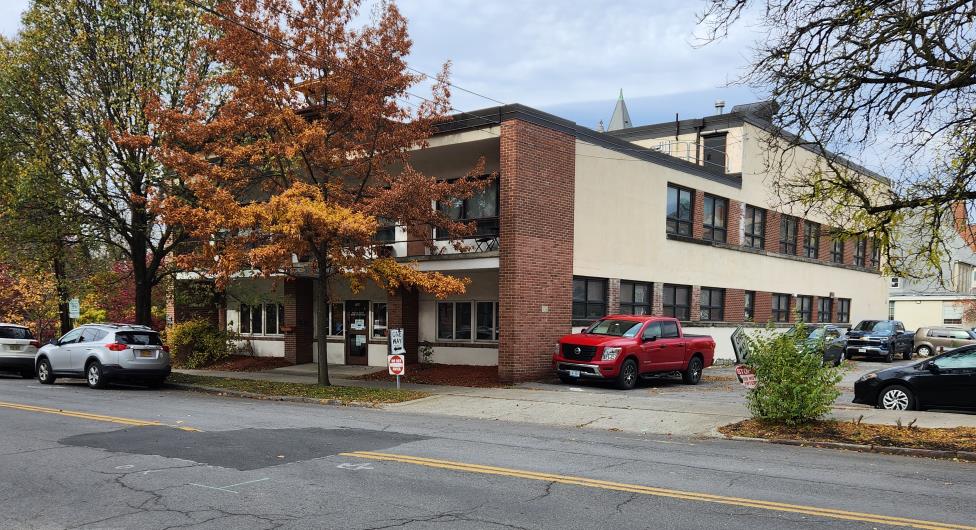
But not only is deconstruction costly, it takes time. Thompson estimated that taking pains to salvage usable materials along with all the abatements could consume a full eight months.
But if the asbestos abatement costs can’t be avoided, could other expenses be shaved? Might Tompkins County save money by not salvaging anything; by simply carting all debris to the landfill?
“I can’t help but wonder something that is so long and protracted a process, requires an on-site supervisor… and we’re not even sure there’s a market for a majority of the materials,” legislator Deborah Dawson asked Thompson and LeMaro, “why are we doing this?”
The rationale is community pressure. Preservationists welcome, well, preservation. And County leaders bowed to preservationists early-on. They did so in part to lessen community objections to taking the buildings down. And as much as Dawson might think differently, others are reluctant to budge.
“We just saw the East Wing of the White House demolished in a very few days. It shocked the country,” Dryden’s Mike Lane reminded the committee. “And so I think as we go forward, we’ve got to think about how people will react if we just go in and push it down.”
Dawson saw an opening. Midway through Lane’s admonition about East Wing razing, she interjected, “You think we could get those guys?”
At the Legislature, Randy Brown described the Election Day meeting of the Downtown Facilities Committee as “the longest meeting to date.” From the public’s perspective, that can’t be said. The Tuesday session’s public portion ran only 45 minutes.. Meetings of the committee have run longer. It suggests that the executive session of the committee Brown called that day was the long part, perhaps rivaling in its length the later discussion Brown had requested of the full Legislature.
“I think maybe the discussion in executive session provides some broader context,” Groton’s Lee Shurtleff said, albeit hesitantly, in inviting closed doors. “But you know, it’s not typically something to come out of executive session and take action or vote,” Shurtleff advised.
Customary or not, that’s what the Legislature did.
“I would prefer to do it right now,” Legislature Chair Dan Klein stated his preference for immediacy, Klein apparently seeing no need for a closed-door huddle prior to a vote on deconstruction funding. Mike Lane agreed with Klein.
Yet Randy Brown prevailed. And Klein bowed to Brown’s wishes. After finishing other business, the Legislature shuttered its doors—and its video stream—and employed the “real estate exception” to New York’s Open Meetings Law. The exception allows private consideration of the “proposed acquisition, sale or lease of real property,” when publicity would potentially affect the property’s value.
To lean upon that clause to address only the razing of buildings government already owns could stretch state law beyond its breaking point. But were the Legislature to also weigh abandonment of the Center of Government project altogether in favor of other options, such as purchase of available buildings in the Cornell Business Park or the more recent offer by owners of Harold’s Square to sell or lease vacant office space in the high rise they own on the Commons, the leap to justify comes easy.
We, the public, may never know, of course, what was discussed. Legislators sequestered themselves behind locked doors at about 9:20 Thursday night. They reconvened at about Eleven. They took their vote, and then they went home.
Yes, it would have been nice had on this important a matter—an eight-figure investment whose costs keeps climbing, and climbing fast—that a public body whose members we elect to do our bidding had conducted their public business in public.
But that’s not been how the Center of Government has tended to be handled. And that secrecy dates back to when former County Administrator Molino and legislative leaders kept their efforts to buy the Key Bank and law office buildings sheltered in silence for years. Those in the world of real estate likely knew what was going on. But we in the public couldn’t be told.
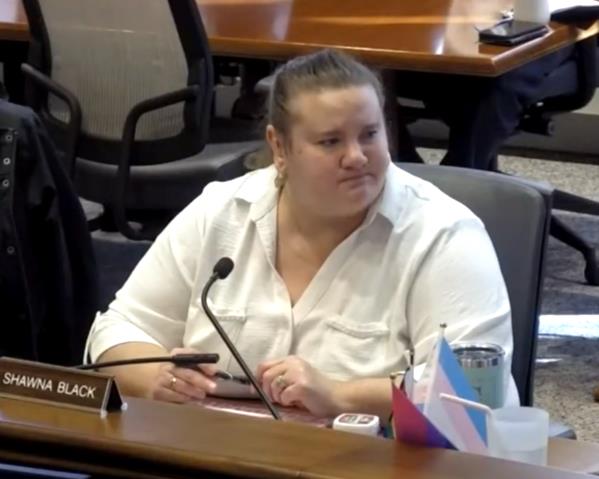
So, for now, we must rely on the cautionary words spoken in committee by legislator Shawna Black, a Center of Government supporter, but one who’s wary of public and colleague jitters.
“I’m afraid that the higher we get and the more expensive this project gets, the more likely we are to lose legislators that are behind the project,” Black told the Downtown Facilities Committee Tuesday. “And I think probably we could be at the tipping point of legislators that are ready to not support this project,” she warned.
And to colleague Dawson’s estimate of a 30 million dollar cost increase over this past half-decade, Black opined:
“So we’ve doubled the project in the past eight years that I’ve been on the Legislature. I understand the fact that if we don’t do it soon it’s going to keep doubling. But I feel like this is a runaway train at this point,”
Again, Black spoke at a committee meeting; not on the floor of the full Legislature on the night it voted to spend $2.6 Million of your money not really to build anything up, but instead to rip something down. Candor and transparency are nice, at least when you can find them.
###
A Town Divided: Incumbents lead in close Enfield Election

by Robert Lynch; November 4, 2025; new reporting, November 5, 2025 @ 9:12 PM
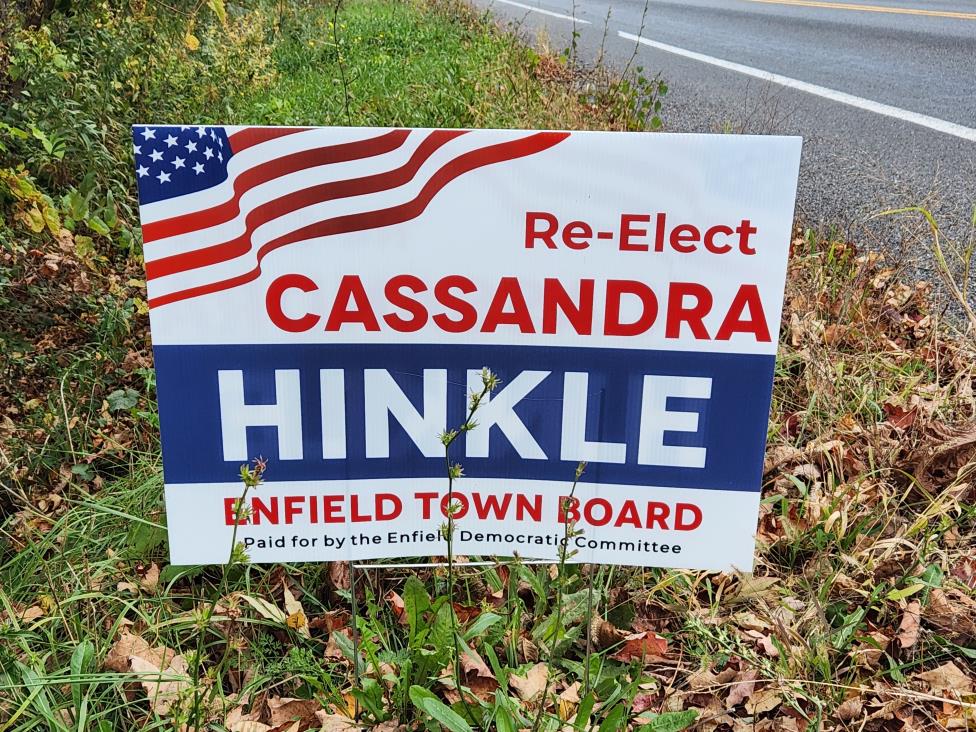
Their victory may prove hard to stop. Enfield incumbent Democratic Councilpersons Jude Lemke and Cassandra Hinkle have taken the lead in a close election for two Town Councilperson seats. Yet still uncounted absentee ballots could influence the final election outcome.
Updated Board of Elections tallies that combined same-day in-person voting with previously-cast early voting and already-counted absentee ballots late Tuesday put incumbent Jude Lemke in the lead in the four-way race for two Town Board seats. Lemke held that lead with 426 votes. Fellow Democratic incumbent Cassandra Hinkle was polling second as of late Tuesday with 409 votes.
If those leads hold, Lemke and Hinkle, each completing their first, full four-year terms on the Enfield Town Board, would each secure another term in office.
“We did it,” Councilperson Hinkle posted on her Facebook page early Wednesday morning. “Thank you sooo much to everyone who helped Jude and I on this win. It was a very close race, and I am grateful to serve Enfield for another 3 years,” Hinkle stated.
Polling third at this moment was challenger independent Rosie Carpenter, who claimed 394 votes, just 15 votes behind Hinkle. Challenger Robert Tuskey placed fourth at 343 votes.
Absentee ballots can still add to the total, as they are received by the Tompkins County Board of Elections in future days, so long as they were postmarked by Tuesday, November 4, Election Day.
“Both Rosie and Bob conducted strong campaigns that they should be proud of. I am honored to have been re-elected to represent the residents of Enfield,” Councilperson Lemke wrote late Wednesday in a statement. “I hope this campaign has raised awareness and that more residents will participate in Town Board meetings in the future.”
To stage an upset over Hinkle, challenger Carpenter will have an uphill fight.
Only 28 circulated absentee ballots were unaccounted-for in Tuesday’s tally, according to a Tompkins County Board of Elections spokesperson contacted Wednesday morning. Those ballots were mailed, but had not yet been received to be included in the Election Night returns. Add to those 28, another eight “Affidavit Ballots,” votes attempted to be cast at the polls Election Day, but not included because of various questions by elections inspectors..
Elections’ officials have no way to project how many of the still-unreceived absentee ballots, properly postmarked, will indeed be received by the Wednesday, November 12 deadline for their receipt. To surpass Hinkle, Carpenter would need to receive an overwhelming majority of the uncounted absentee and affidavit ballots, effectively getting 16 more of those votes than would Hinkle.
The contacted Board of Elections spokesperson indicated that while a partial tally of received Absentee Ballots may be possible next Monday, November 10, an update may not be issued until after the November 12th, 5 PM deadline.
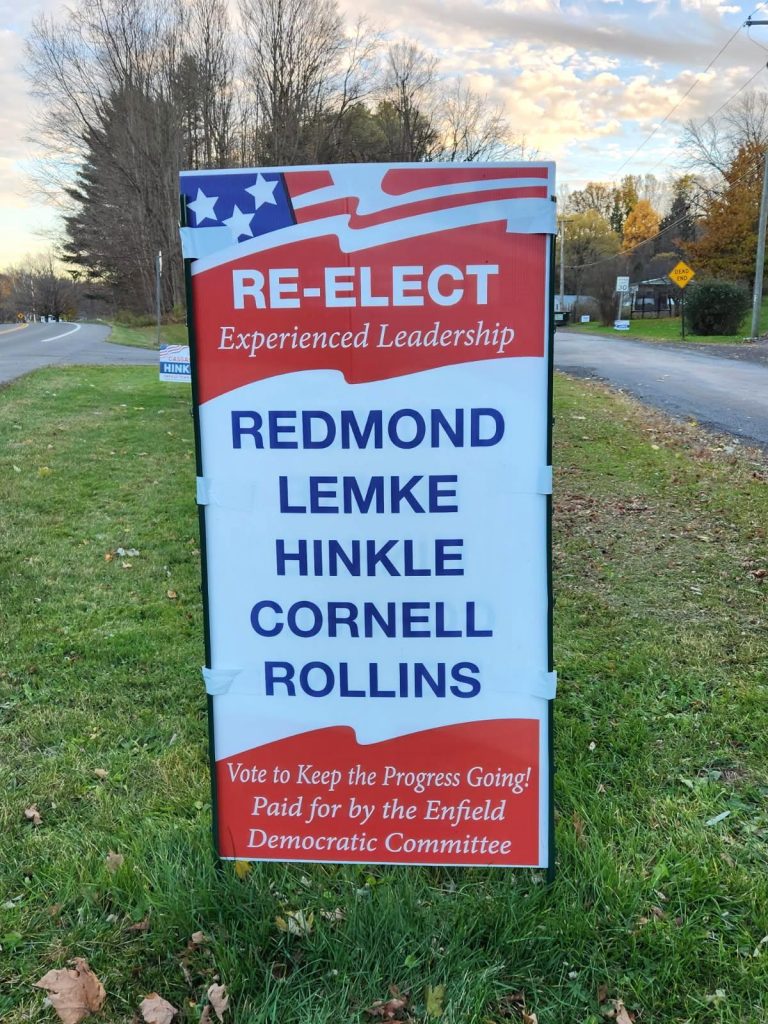
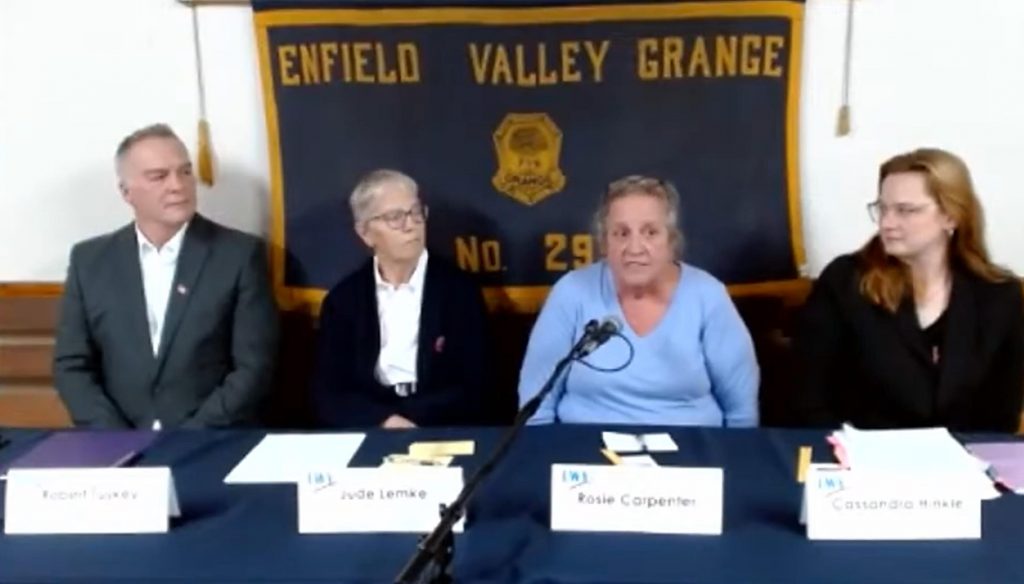
In the Enfield election, incumbents Lemke and Hinkle campaigned as a team carrying the Democratic Party endorsement and supported by the party organization. Carpenter and Tuskey, likewise aligned themselves as a team and proceeded toward the election generally self-funded.
All other Town of Enfield offices, including that of Town Supervisor, were uncontested this election cycle. Town Supervisor Stephanie Redmond won without serious opposition, as did Town Clerk Mary Cornell and Highway Superintendent Barry “Buddy” Rollins.
“I thank everybody that came out and voted and gave their support,” Rosie Carpenter, contacted Wednesday morning, said following her narrow apparent defeat. Carpenter declined to issue a formal statement pending the final count of absentee and affidavit ballots November 12 and declined to concede the race until then. “I am very happy with what the people did,” Carpenter said, commending her supporters. People should “pay attention to what’s happening in their town.” Carpenter advised.
Robert Tuskey, the apparent fourth place finisher, Wednesday touched on the positive benefits derived from his campaign.
“I enjoyed meeting with people I hadn’t seen in a very long time, for decades and hearing their stories,” Tuskey remarked the morning after the election. “It was a breath of fresh air to see the heart of the community and hear issues the Town Board is considering,” Tuskey added.
“There are many benefits that came out of this,” Robert Tuskey said of his now-concluded campaign.
Other Races:
Among other noteworthy races around Tompkins County, Democratic incumbent Town Supervisor Katelin Olson defeated by a more than two-to-one margin her independent opponent Supervisor candidate Katherine Lou Walker. Unofficial tallies gave Olson 994 votes, Walker 437.
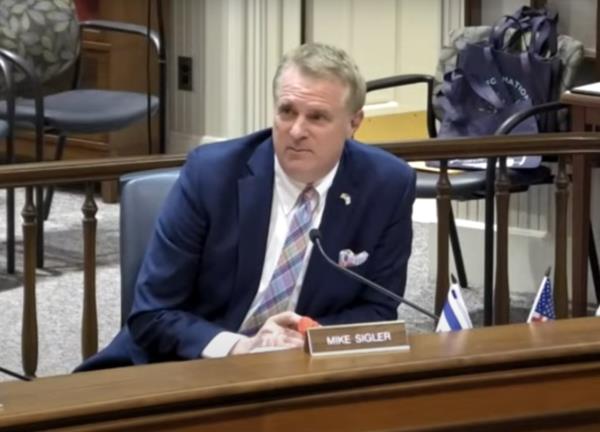
In Lansing, in the most hotly-contested race for Tompkins County Legislature, incumbent Republican Mike Sigler beat Democratic challenger James Perkins. Sigler won with 1215 votes (54.5%) to Perkins’ 969 (43.5%), with an additional two percent of write-ins.
Meanwhile, the race for Lansing Town Board ended the night as a free-for-all, its outcome complicated by the last-minute entry of two write-in candidates to challenge the Democratic incumbents.
The only thing certain in Lansing is that incumbent Judy Drake, now running as a Democrat, will keep her Town Board seat. Drake prevailed with 1763 votes. But the other incumbent, Democrat Joseph Wetmore, has found himself four votes behind one of two write-in positions. Wetmore got 1585 votes. One write-in slot got 1589 votes, the second 1424 votes.
In the final weeks of the 2025 campaign, two write-in aspirants, John Duthie and Joe Lovejoy, entered the race for Lansing Town Board, their entry prompted by Lansing’s growing controversy over the proposed TerraWulf power plant’s conversion into a data center.
As of Tuesday night, it remained unclear as to how many write-in votes were cast for Duthie and how many for Lovejoy. Depending upon how the write-in votes are sorted out between the candidates, Wetmore could lose his seat on the Board to one of the write-ins or he may not. There’ll likely be a recount in any case.
In Newfield, the two incumbents on the Town Board will remain. In a three-way contest for two Councilperson seats, incumbent Democrat Joanne James polled strongest with 519 votes. Republican incumbent Christine Seamon snagged the second seat with 398 votes. Another Republican candidate, Michael Corbett, trailed with 350 votes.
In eastern Dryden, the Tompkins County legislative seat to be vacated by the retiring Mike Lane will remain Democratic. Democrat Dan Wakeman clobbered Republican rival Thomas Corey for the right to succeed Lane, 1046 votes to 350.
Closer to Enfield, across the town line in the Town of Ithaca, Democrat Christy Bianconi beat independent candidate Michelle Wright for the opportunity to succeed the retiring County Legislator Amanda Champion. Bianconi secured 400 votes, Wright 292 votes. Of note, according to media reports, Champion had endorsed Wright to be her preferred successor in recent weeks. It won’t happen.
In Enfield, both seats on the County Legislature were decided without contest. Incumbent Republican Randy Brown will continue to represent southern Enfield. Democratic newcomer Rachel Ostlund, unopposed, will succeed the retiring Democrat Anne Koreman in northern Enfield’s redrawn District 16.
Returning to Lansing, two-term County legislator Deborah Dawson, who this fall abandoned her planned retirement and launched a write-in campaign for reelection, appears to have won that new term, although by a closer margin that some might have expected.
Dawson’s legislative District 7 lies to the south of Sigler’s District 8. Initially in that race, newcomer John Dennis had secured the Democrat’s District 7 nomination. But when fellow Democrat Dawson re-entered the contest, Dennis attempted to drop out. Yet he did so too late to have his name taken off the ballot. In Tuesday’s voting, an unspecified “write-in” candidate, presumably Dawson, secured 56 percent of the vote. Dennis got nearly 44 percent support.
Jude Lemke’s first-place finish in Enfield’s Tuesday elections may have been helped by the Democrat’s springtime endorsement from the Enfield Republican Committee.
Although the initial Board of Elections consolidated compilation of same-day, early, and absentee voting results fails to distinguish votes for Lemke by party, machine results from the Enfield polling location Tuesday indicated that 60 of the 363 votes Lemke secured from same-day voting came from her placement on the Republican line.
Had Lemke not received that Republican support and relied on Democrat votes alone, Lemke might have fallen to fourth place, behind Tuskey’s 323 same-day, in-person votes. In the final analysis, the ballot line distinction doesn’t matter.
Anecdotal evidence gleaned from door-to-door solicitations during the campaign’s final days suggests that despite the many yard signs that competing candidates had planted around Enfield, despite a four-way candidate forum October 14 at the Enfield Grange, and despite at least one media profile, some who had voted on or before Election Day knew little about the contested Town Councilperson races and knew little about who was running.
Rosie Carpenter and Robert Tuskey relied heavily upon door-to-door constituent interactions to advance their ideas and images, either through contacts by themselves or by their supporters. Lemke and Hinkle appeared to have relied more on community events and party-sponsored publicity. The extent of Lemke’s and Hinkle’s own door-knocking efforts were not immediately ascertained.
Doorstep interactions—including those by this Councilperson/writer, a Carpenter and Tuskey supporter— revealed among those who favored the challengers a pervasive discontent with the Enfield Town Board’s current direction. At times, the opposition grew personal. To an extent, this year’s election results reflected that discontent.
Lemke and Hinkle, as well as Carpenter and Tuskey, allied themselves as teams that obliterated party distinctions. Had Lemke’s and Hinkle’s votes been combined, they’d have totaled 835, or 53.1 percent of the consolidated number of votes cast. The combined votes for Carpenter and Tuskey would have totaled 737, or 46.9 percent. That’s about a six percent spread. Yet it’s still reflective of the divided political sentiments within Enfield.
And consider another telling statistic, one likely reflective of community discontent. In winning the race for Town Supervisor, incumbent Democrat Stephanie Redmond, a close ally of both Lemke and Hinkle, ran without opposition. (Redmond was first elevated to Town Supervisor by appointment in 2021. And elected Tuesday, she will in January commence her third consecutive full term in office.)
Redmond secured 506 votes in Tuesday’s election. But another 19 Enfield voters chose to write-in somebody else’s name instead. More importantly, as many as 288 Enfield voters chose not to vote for Town Supervisor at all.
Adding it all up, it means that of the 813 votes potentially available to cast for Supervisor in the election, only 62.2 percent of voters supported Stephanie Redmond, leaving 37.8 percent of the electorate choosing not to support her continuation in office.
Redmond’s lack of affirmation should be compared with that for two other uncontested offices in Enfield. A full 85.5 percent of total voters chose to reelect (uncontested) Town Clerk Mary Cornell. More than 80 percent affirmed the reelection of Barry Rollins to another term as Highway Superintendent, Rollins likewise unopposed.
Clearly, among those who voted, Supervisor Redmond faces a popularity deficit, more so than does Clerk Cornell or Highway Superintendent Rollins.
Volunteers canvassing door-to-door pre-election encountered at times deep-seated opposition to Redmond’s—and also to the Enfield Town Board majority’s—leadership and management style. Prospective voters who favored Carpenter and Tuskey as alternative Town Board members cited the need for new leadership and pointed toward a desire for greater “transparency” in Enfield Town governance. Transparency had become a recurring theme of the Carpenter and Tuskey campaigns.
Contacted individually Wednesday, Rosie Carpenter and Robert Tuskey reaffirmed their intent to remain engaged in Enfield politics and participate in governmental affairs post-election. “I’m not going away,” Rosie Carpenter was heard to say.
Note: This latest version has been updated to include the comments of Councilpersons Cassandra Hinkle and Jude Lemke on their apparent reelection victories.
###
Posted Previously:
Someday: A place without Bangs
EMS consultant briefs Tompkins leaders on short-term fixes; long-range vision
by Robert Lynch; October 31, 2025
A quarter-century from now, as one emergency medical services consultant foresees it, a governmentally-subsidized service agency will travel the breadth of Tompkins County, answering rescue calls, picking up patients and taking them to wherever. And when it does, privately-owned Bangs Ambulance will somehow just dry up and blow away.
But that’s then, not now. And the problems of today are what Tompkins County hired consultant Paul Bishop to fix.
For nearly two hours this past Tuesday afternoon—at a meeting that sidelined all other business—Bishop, principal of the Rochester-based Center for Governmental Research (CGR), briefed the Tompkins County Legislature’s Public Safety Committee on what it could do to shore up its emergency medical services (EMS). Persistent problems include longer-than-desirable patient wait times, member depletion of volunteer rescue squads, and the increased deployment of paid municipal ambulance crews to extend mutual aid beyond their own boundaries.
“EMS in Tompkins County is not a cohesive system of care,” Bishop concluded early in his October 28 presentation. He stuck close that day to a 27-slide PowerPoint he’d prepared, one that summarized a more detailed written report most of us have yet to see. “Several distinct service models exist dictated by political boundaries (and) generations of choices by political and agency leaders,” the consultant’s overview asserted.
Put another way, EMS in Tompkins County has evolved—or devolved—into competing camps of providers that rub up against each other and create friction. There’s a profit-driven Bangs Ambulance, which can’t keep up with what it’s tasked to do. There’s an amply-paid Ithaca Fire Department that could do more, but won’t. And there are the not-for profit paid ambulance operators in Dryden, Trumansburg, and to a lesser extent, Groton that find themselves asked too often to bail Bangs out, and to do so at their own fiscal detriment.
In April of last year, Tompkins County inserted a new player into the mix, the Rapid Medical Response (RMR) service. Initially designed and funded to gap-fill for volunteer fire department rescue squads during daytimes on weekdays, RMR’s managers earlier this year sought a much-bolder role, one that involved adding multiple ambulances and quadrupling RMR’s staffing and payroll.
Hesitant about whether a grander RMR was the way to go, the Tompkins County Legislature in June retained Paul Bishop and CGR for $48,000 to offer a more detached perspective. Bishop’s report was due in September, but was late in coming. Tuesday’s Public Safety Committee meeting brought its first airing. While they’d waited for the report, legislators this fall budgeted another year of continued RMR programming, keeping RMR much the way it was when it began and the way it remains.
To an extent, Bishop’s immediate recommendations endorsed the Tompkins County Department of Emergency Response (DoER) proposal for short-term expansion of the RMR program, a plan that would purchase one or two ambulances and secure an all-important “Certificate of Need” from New York State.
But it was Bishop’s “Vision for the Future,” his quarter-century futuristic forecast, that prompted the greatest attention among lawmakers. And it could also eventually generate the toughest scrutiny from those not in the room that day.
“A single provider that was adequately staffed, well led and properly funded covering the whole county would lead to better patient outcomes for the residents and visitors of Tompkins County,” Bishop’s report boldly concluded. “There are enough ambulances and close to enough EMS providers to staff this system,” the consultant’s PowerPoint “Slide 25,” much-referenced, proclaimed.
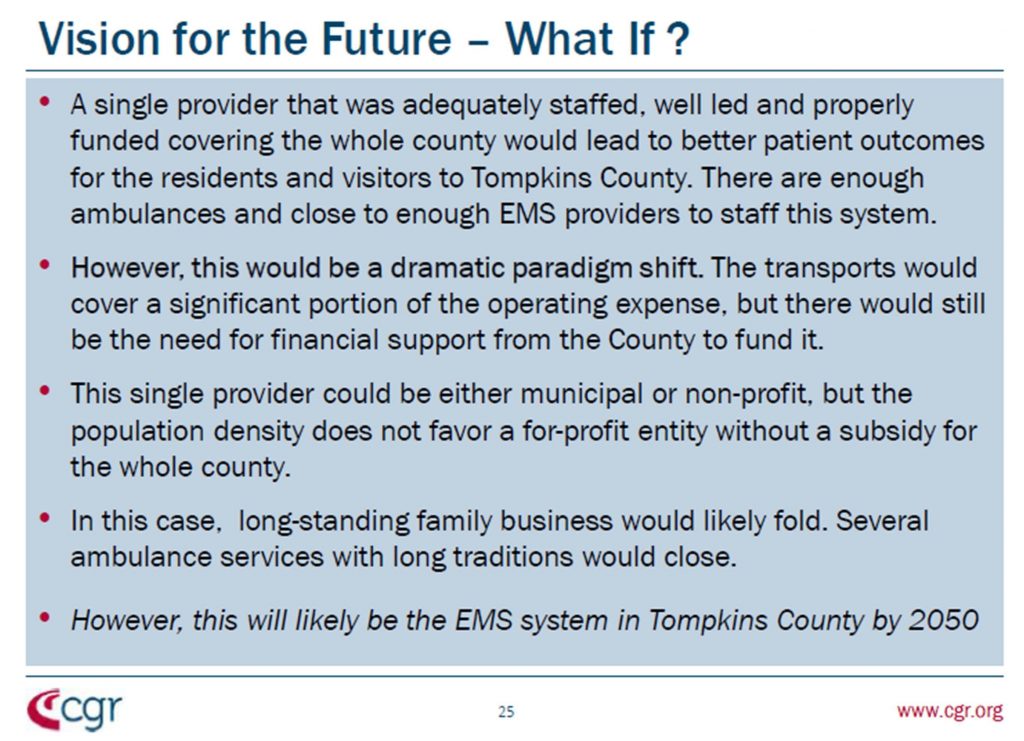
”However, this would be a dramatic paradigm shift,” that same slide acknowledged. “The transports would cover a significant portion of the operating expense, but there would still be the need for support from the County to fund it.”
CGR’s 2050 scenario envisions that the single provider would be governmentally-owned or a non-profit agency. But it would not be Bangs.
“If you were to move there,” that is, to a single-provider service, Bishop advised the committee, “Bangs would have a hard time operating,” he said. “If all Bangs was responsible for was covering the City and Town of Ithaca, they could probably do it financially. But we asked them to go or they volunteered to go outside and that really kind of pushes their resources,” Bishop concluded.
“Did Bangs weigh in on your 25-year projection?” Lansing legislator Mike Sigler cautiously asked the consultant at the close of his formal presentation.
“No,” Bishop quietly answered.
Tellingly, unlike during a prior committee review of EMS options in May of this year, no representative from Bangs Ambulance sat in legislative chambers last Tuesday.
And Bangs’ presumed demise would only reflect part of the change.
“Several ambulance services with long-standing traditions, Trumansburg, Dryden, Groton, they would close if you go to a single service,” Bishop predicted within his, over-the-horizon vision of consolidation. “However, this is probably where you’re going to be in 2050,” he said. “You’re going to be at a single agency providing it for the whole county.”
“I can’t speak for Dryden or Groton, but I can speak for Trumansburg,” that village’s mayor, Rordan Hart, told the committee from his virtual perch. “We do not run an ambulance service because we really want to be in the ambulance business; we run an ambulance service because if we didn’t operate there would be no one, including Bangs or anyone to our north, capable of stepping in and picking up the calls that we currently cover.”
CGR’s statistics, presented to the committee, reported that Bangs Ambulance handles about 12,000 calls per year. Dryden Ambulance handles 2,500, roughly one-fifth as many as Bangs does. Trumansburg Ambulance responds about 1,000 times; Groton, 750. Bangs has up to a half-dozen ambulances in service, it was said. Dryden has two. Trumansburg has one.

“What would it cost for a full-blown county ambulance service with 10 to 15 rigs round the clock similar to where we are today?” Groton legislator Lee Shurtleff asked. Shurtleff threw out the estimate of $10-15 Million, with perhaps one-third of that cost recouped through patient insurance reimbursements.
The Groton lawmaker put side-by-side Bishop’s long-range vision and the consultant’s narrower, short-term fix, that is, the one-to-two ambulance RMR expansion.
“But your impact on the taxpayers to run a countywide service is far more than that $2.5 Million that’s quoted here,” Shurtleff said, pointing to the RMR expansion quote.
“You’re talking apples and oranges,” Bishop responded. “That $2.5 Million was for a small apple. And (with county-wide service) we’re talking about a very large orange.”
To defray potential expenses—those that inevitably arise when government owns something—Bishop, instead, envisioned setting up a governmentally-subsidized nonprofit corporation. He nicknamed it “Tompkins County Ambulance, Inc.”
As to the more immediate priorities, the CGR report that Bishop presented pointed Tompkins County down two alternative paths. Each would expand the Rapid Medical Response program under a county-wide Certificate of Need and permit RMR staff to elevate to paramedic-level care, most likely with ambulances in service or at least at the ready.
“This is not to supplant an existing service,” Bishop was quick to qualify concerning his short-term recommendation. “We’re not trying to take any territory or calls, first calls away from anybody here.” Instead, Bishop said, “The goal is to fill gaps, to prevent draining resources from outlying areas, and to be a safety net provider when other sources are depleted.”
The more modest of the short-range options, called the “Bridging Gap Ambulance Service,” would purchase one paramedic ambulance, make it ready 24/7, but deploy it only sparingly. There’d be another paramedic first response vehicle in house and a staffing budget of $1.7 Million. That’s about 2.5 times RMR’s current cost.
The other, more ambitious “Safety Net Ambulance Service” would purchase two ambulances. Only one would provide paramedic-level care. There’d be added staff and a $2.5 Million price tag, 3.6 times RMR’s current budget.
And ambulances come neither cheap nor quickly. Bishop predicted each would incur an additional quarter-Million dollar expense and take 18 months to deliver.
“Ambulances are not inexpensive,” Bishop acknowledged.
If going for that second, pricier option—the one more resembling what DoER staff had proposed last spring—“Dryden and Trumansburg would never have to leave their towns,” Bishop predicted.
Yet just how often would that expensive, taxpayer-paid County ambulance actually leave the station? At least with the “Bridging Gap” option, maybe not often.
“You can choose to run the ambulance only now and then, as long as you’re providing that paramedic service regularly,” Bishop said regarding the less expensive choice.
“How would that work?” Legislature Chair Dan Klein asked, puzzled by the prospect that an expensive new “backfilling” tool might only be deployed twice a month. “That crew is just sitting there on call all the time, or are they in one of our other EMS programs?” Klein inquired.
Bishop said crews would be doing other tasks in other vehicles, although he never convincingly addressed Klein’s question with specificity.
Also left somewhat undefined was exactly how County Government and local municipalities might share any obligations to underwrite the service either short- or long-term. Bishop made clear that current state law forbids counties from establishing county-wide ambulance districts or imposing a county ambulance tax.
“I think that would be a great idea if you could,” Bishop said of countywide ambulance taxation. He urged Tompkins to band together with other counties and lobby Albany lawmakers.
And Paul Bishop’s advice on funding alternatives may have been the least convincing part of CGR’s presentation. The consultant referenced Madison County—no doubt, much different from Tompkins—where a county-wide tax, apparently imposed within the General Fund, gets paid-in disproportionately by towns that lack ambulance service, and paid out to those that have one.
Perhaps an inapt analogy, the consultant equated ambulance funding to underwriting the Sheriff’s road patrol.
Paul Bishop’s report touched on many areas, one or more of which involve tricky turf wars maybe unique to Tompkins County.
There’s the bureaucratic obstacle that may explain why Bangs Ambulance finds itself so overstretched. It’s the refusal by paid Ithaca Fire Department (IFD) staff, contracted to serve the Town of Ithaca as well as the City, to respond to low-level non-emergency calls, like when a frail older adult falls out of her chair or a nursing home patient needs a bed lift. In Enfield, under Fire Chief Jamie Stevens’ recent directive, fire company rescue squads get dispatched to those low-level calls. But in Ithaca, the job is left to Bangs.
“The Ithaca Fire Department has decided that they are only going to respond to the ones that they believe…are life-threatening,” Bishop advised the committee. “And that is still close to half of their calls.”

A second conclusion the CGR study drew is that the 911 Center and local ambulance providers need to triage their medical emergencies. Bishop said the Center right now expects every call deserves a dispatch within a set time, perhaps five minutes. That, he said, should change.
“You don’t need to have an ambulance assigned for someone who has low back pain that they’ve had for a week and now they want to go up to (Cayuga Medical Center),” Bishop observed. “They can wait 20, 30, 40 minutes for an ambulance to show up.”
There’s also a lack of transparency as to how much 911 dispatchers know about Bangs’ operational adequacy or lack thereof, the study found.
“The dispatchers need to know Bangs’ status,” Bishop told the committee. They need to know how many ambulances are available for Bangs. “The other agencies already share,” he said. But with Bangs, “There’s a feeling that it’s proprietary and somewhat dynamic.” CGR was told by Bangs that its status “can change hour-to-hour.”
DoER Director Mike Stitley and Joe Milliman, administrator of the RMR program, each deferred comment October 28 on the CGR report. Bangs’ representatives weren’t there, of course. And municipal representatives of Dryden and Trumansburg proved cautiously supportive. Expect the CGR study to get its next full examination at a meeting of the Tompkins County Council of Governments (TCCOG) December 11.
Paul Bishop predicted that his single-provider countywide ambulance service would come to pass by 2050. Trumansburg’s Rordan Hart believes it may arrive much sooner, maybe by 2035, just a decade from now.
“We’re going to get to a place where the Dryden’s and the Trumansburg’s either can’t, or won’t, or won’t be able to afford providing these services,” Hart told the Public Safety Committee. “How do the small agencies feel about it? I think at worst we believe it’s inevitable and at best we would welcome it simply because of the tax burden to our taxpayers who are providing the service that we already do.”
That “Slide 25,” the one predicting an in-the-future, single-provider service, seems the one most important, Tompkins County Administrator Korsah Akumfi advised committee members that day. “And it is essential that all the partners read that, understand it, and think through the processes and identify what we need to do to solve the problems everybody admits exist,” Akumfi, on the job for less than a year, advised the committee.
Of course, those who must read the report include Bangs Ambulance. And no one likes to read that you’ll be put out of business.
###
Posted Previously:
Enfield Board ups Road Equipment line; adopts budget
by Robert Lynch; October 22, 2025; additional reporting October 25, 2025
Disagreements erupted, and the vote was not unanimous. But the Enfield Town Board Wednesday night adopted its final 2026 Town Budget following a public hearing where at least one commenter, a candidate for Town office, suggested that Supervisor Stephanie Redmond and Town Councilpersons serve next year without a pay raise and perhaps even work for free.
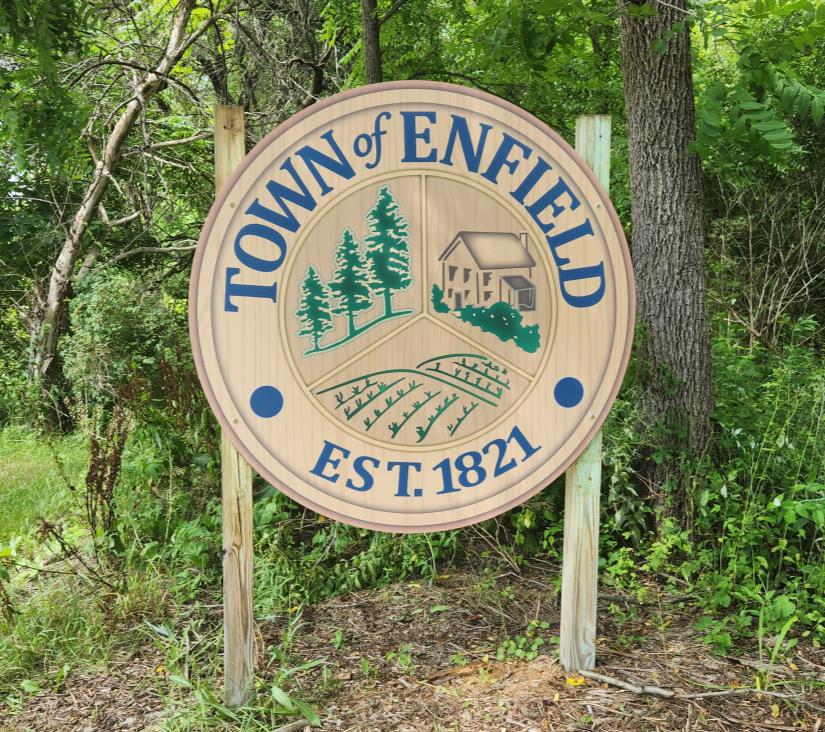
The $2.67 Million final Enfield budget would increase next year’s property tax levy by 6.53 percent. The tax rate, the amount per thousand that property owners pay per their assessments, would rise by 4.76 percent and stand next year at $6.84 per thousand.
The Enfield budget passed on a four-to-one vote October 22. Approval followed a sometimes-testy half-hour of discussion among Town Board members. Central to the controversy was Supervisor Stephanie Redmond’s last-minute initiative to transfer an additional $100,000 from an accumulated multi-year “Equipment Reserves” account into a budget line that Highway Superintendent Barry Rollins could spend at his discretion without Town Board review or consent.
As amended, Rollins discretionary equipment line will now have $375,000 in it for the superintendent to spend on machinery in 2026. The earlier “Preliminary Budget,” the one that was the actual subject of the evening’s Public Hearing, had set the spending line at $275,000. It had been only $140,000 in the initial 2025 Budget, but then climbed upwards during the year.
Councilperson Robert Lynch (this writer) equated the $375,000 equipment allowance to a “blank check.” He noted that Rollins could spend the money without consulting the Town Board, let alone getting its permission.
This Councilperson, Lynch, voted against the $100,000 transfer and also against the final 2026 Budget. He cast the lone vote in favor of an amendment, one suggested by a hearing commenter who’s also a candidate in this year’s elections, to have Town Board members forgo their planned three percent 2026 raises in the name of austerity.
“This budget… puts things ahead of people,” Lynch insisted, noting that at a prior meeting two weeks earlier, the Board’s majority had declined to increase annual salaries for Town Justice Heather Knutsen-King and her court clerk each by $530, but had no problem supporting a new $165,000 tractor for the Highway Department.
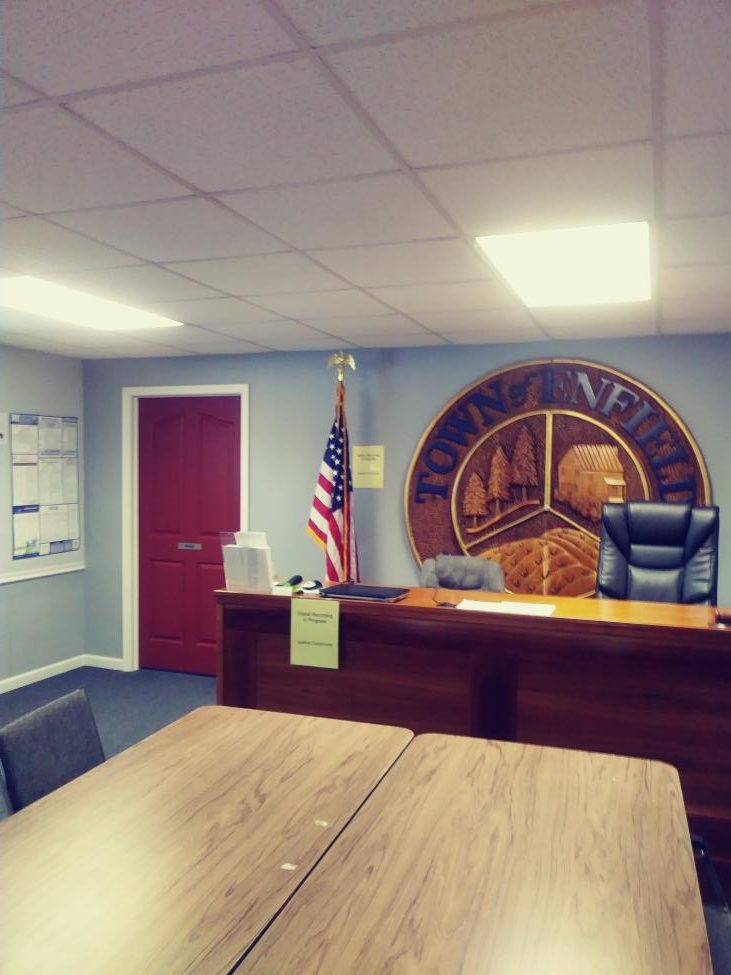
Other Town Board members, led by Redmond, resisted rolling back their own planned raises. Redmond maintained that adequate member pay encourages residents to serve in government and avoids having only persons of privilege running for office.
The pay-critical hearing commenter, Independent Councilperson candidate Robert Tuskey, faulted board members for not considering taxpayers as well as themselves.
Pointing to the projected nearly five percent increase in the tax rate, Tuskey said, “To me, that just hinders somebody’s ability to put food in the refrigerator and onto the table and keep their property more than you getting your little bit of an increase.”
Robert Tuskey and Rosie Carpenter are each challenging incumbent Councilpersons Jude Lemke and Cassandra Hinkle in this year’s Enfield Councilperson races. Carpenter also attended the hearing, but limited her comments to reciting the Pledge of Allegiance.
Supervisor Redmond defended the added $100,000 transfer of reserve funds to the Highway Superintendent’s equipment line, saying it “allows him to work more efficiently” in that Rollins can buy used equipment at auction without first returning to the Town Board and requesting a special meeting.
“I feel like he’s never led us astray with his purchases,” Redmond maintained. “He’s always been very capable of figuring out what we need and whether it’s a good deal,” she said.
Redmond qualified that “there’s an expectation” that Rollins would expend funds only on the machinery listed in a multi-year, sometimes-changing “Capital Plan,” a document attached to the 2026 Budget, yet not formally endorsed along with it. “So it’s not like he’s going to take it out and spend it at Walmart,” Redmond said of the superintendent’s purchasing authority.
The Capital Plan, however, does include the $165,000 new tractor.
“But let us say if he finds the new tractor, and ‘oops,’ the price has gone up; it’s now $225,000,” this Councilperson, Lynch, countered. “He’s got the money in that budget to write that check for $225,000.”

“That’s how policies work with these equipment lines,” Redmond explained.
“And that’s reckless,” this Councilperson rebutted.
While most accounts remain open to subsequent revision during the budgeted year, Rollins made clear during Wednesday’s meeting that once the reserve funds transfer to his equipment line, only he, not the Town Board, controls them. Even were the Town Board’s composition to change next year—which it may—the $100,000 infusion of cash could not easily be pulled back out.
It’s up to me,” Rollins insisted, “Highway funds are highway funds.”
Nonetheless, by law, equipment money unspent by the Superintendent during a calendar year would revert to the reserve account at year’s end. Budget documents presented the Board Wednesday placed the equipment reserves account currently at just over $321,000. Barring any subsequent rollover savings, the drawdown would shrink equipment reserves to $221,000 by this time next year.
Because the $100,000 Redmond requested for equipment is only a budget transfer—and not new money—the Board’s action has no immediate impact on the tax levy or the tax rate.
During both the Public Hearing and in later Board discussion, Supervisor Redmond pushed back on the idea of eliminating Town Board raises or to Robert Tuskey’s overture of returning to a bygone era when those governing a town served without pay.
“We feel the same inflation in our pocketbooks as everybody else does,” the Supervisor advised Tuskey at the hearing. Redmond then advanced a philosophical justification for increasing legislative pay.
“The other issue that I have with people not getting paid is then you have a very financially comfortable to the point of privilege viewpoint as our public servants,” Redmond said. “You cannot have somebody in a community that cannot afford to give their time away. You can’t have it from a single mom. You can’t have somebody that’s not supported otherwise either through marriage or whatever.”
“I think there is a significant population in Enfield of people that are underprivileged and need to have that voice recognized on their Town Board,” Redmond continued. “They need to have people on the Board that know what it’s like to choose between groceries and rent, and you know, anything you can put on their credit card.”
Still, Tuskey pressed his defense for citizen-service.
“It is what it is. Serve the people. Show ‘em how you’re committed,” Tuskey counseled the Town Board. “Find another way to do it. Where there’s a will there’s a way. Nothing is impossible.”
The candidate’s comment struck a nerve with one Board member.
“I feel like that’s an incredibly privileged thing to say,” Melissa Millspaugh, a teacher and a Board member who’s not up for re-election this year, countered Tuskey, “as two of the Board members here leave our small children at home every single time we’re here for hours.” Millspaugh has two young kids.
“I object to being called privileged,” Tuskey bristled.
Millspaugh clarified that she‘d referred to Tuskey’s comment, not to Tuskey himself. The candidate said he took the inference, nonetheless.
Town Clerk Mary Cornell intervened. She reminded Millspaugh that the hearing is for the public to speak, not necessarily for Board members to do so.
Near the end of budget discussions, this Councilperson, Lynch, moved to eliminate the three-percent raises that Supervisor Redmond and all Councilpersons would receive. The revision lost on a four-to-one vote. Had it passed, the revision would have saved the Town $812 in annual Supervisor’s pay, and a collective $467 among remaining Board members. Yet it would have sent a message.
Councilperson Cassandra Hinkle—one of two incumbents on this year’s ballot—seconded the Lynch motion for the salary rollback, but then voted against the reduction.
“I’m going to ask you to please not do that to yourself,” Supervisor Redmond counseled Hinkle regarding the pay cut,” because you have to think about people that are coming after you.” Redmond referenced the hypothetical unmarried woman who must pay out-of-pocket for health insurance and can’t “ride on” their husband’s policy.
“We’ve spent years trying to get caught up,’ Councilperson Jude Lemke said of efforts to raise Enfield officers’ pay to respectable levels. Lemke, a retired attorney, accepts no compensation. Yet she specifically urged against cutting Supervisor’s pay, a salary now set to rise in 2026 to $27,865.
“4.76 percent; that’s quite a bit,” another hearing commenter, Marcus Gingerich, said of the proposed, and later adopted, tax rate increase. Gingerich had spoken just one night earlier on Enfield’s Fire District expenses as the District’s Board of Fire Commissioners took its own testimony—and later adopted—a much-smaller, yet still increasing, $638,631 Fire District Budget.
To counter Gingerich, Redmond stated that reducing “anything else is going to be a cut to services.”
As for the Highway Department equipment funding transfer, Redmond never revealed her plans to all other Board members prior to convening the evening’s hearing. The initiative caught this Councilperson, and perhaps others, by surprise.
“I was going to support the budget tonight before the amendment came down,” this writer stated prior to his voting against the budget. “I can’t support it now, and I can’t support it primarily because… I’m voting implicitly for the 2026 Capital Plan which I cannot support.”
Supervisor Redmond that night repeatedly described the Town’s ten-year Capital Plan as a “living document.” Generally it does not receive a separate vote, and it didn’t receive one at Wednesday’s meeting. The last such formal vote, as recorded in the Town Minutes, was in November 2019, a time when Beth Magee was still Town Supervisor. For years, Supervisor Redmond had ignored drafting a Capital Plan until this Councilperson had prodded her to do so.
Nevertheless, as Town Bookkeeper Blixy Taetzsch clarified at the meeting, one’s voting in favor of the budget implies support for the capital purchases—including, most notably, the $165,000 mower tractor—that the Capital Plan expects budgeted funds will buy.
Last July, Highway Superintendent Rollins, with Town Board endorsement, sought to buy at auction a 2022 mower tractor that might have cost only half of what’s now budgeted. But his purchase attempts fell through, and the failure eroded relations between the Highway Superintendent and this Councilperson.

The new tractor would replace a 2004-2005 tractor that Rollins in September had listed in “good” condition on his equipment inventory.
“It’s not broken; it’s not hurting; it says maybe it could take $5,000 to fix up,” this Councilperson, Lynch, told Town Board colleagues about of the existing tractor, based on Rollins’ inventory. “Now maybe in the scheme of things for the Town of Enfield, a 2004 tractor, 2005 tractor is junk. I’ll tell you, for a good many farmers in Enfield, that tractor, 2004 tractor, would be just nicely broken in.”
“And I think we’ve got to learn that we’re not a rich town,” this Councilperson continued. “We’re not the Town of Ulysses; we’re not the Town of Dryden; we are not the Town of Ithaca. We don’t have the tax base. And our taxpayers are hurting, and they say, where can we cut?”
“I just think we are putting our priorities wrong,” this writer closed his argument, reminding the Board of its earlier refusal to increase Town Justice pay, yet supporting new highway machinery. “For a board that seems to think it cares about human beings, we are not caring about human beings. We are not caring about our Town Justice like we should, but we are caring about buying flashy new equipment that is replacing something that we could live with what we’ve got.”
“And that’s why I cannot support this budget,” the statement concluded.
Even had they wanted to, other Town Board members could not have raised Justice Knutsen-King’s salary that night. Once a spending plan advances to “Preliminary Budget” stage, as it had two weeks earlier, law prohibits further raises for elected officials.
Matters not mentioned at either the Public Hearing or during Board comment Wednesday, yet still significant within Town finances, were that for the first time the 2026 Enfield Town Budget has set aside funds for a quarter-time administrative assistant at the Highway Department.
From a fiscal perspective, the budget also draws down the projected available General Fund Balance—the Town’s savings account—to no more than $27,183 above the $250,000 threshold that past Town Boards, through policy, have insisted be reserved for emergencies.
To contain the 2026 tax levy, Supervisor Redmond had recommended, and the Board’s majority later agreed, to tap $182,500 from the existing General Fund Balance to cover operations for the year ahead. Should a similar amount be syphoned off one year from now in the 2027 budget, the available surplus beyond the established policy limit could be more than depleted.
Note: An earlier version of this story had misstated the age of the mower tractor that the new purchase would replace. As stated in various documents, the older tractor was purchased in 2004 or 2005. / RL
###